NAGAWORLD
INTRO: Welcome to Who Killed Haing Ngor?
I’m still in Singapore, where I’ve been looking into organized crime syndicates.
Singapore, of course, is a global financial hub. The government is notoriously strict. It cracks down on criminal activities, large and small – all to maintain its role as an international financial powerhouse.
It’s also notoriously difficult to get Singaporeans to speak candidly about Singapore’s flaws. The risk is just too high, in a country with an existential need to maintain its squeaky-clean reputation.
One topic Singaporean authorities would rather avoid talking about? Triads. And gangs. In the 1960’s and early 1970’s, Singapore was a hotbed of organized crime.
Singaporeans are human. They’re not magically immune to the temptations of crime, no matter what image the government wants to project. Some are involved in narcotrafficking, money-laundering, unlicensed crypto -- the full range of illegal activities, the same as any other nationality.
But– there’s a key difference: most are smart enough to commit their crimes OUTSIDE of Singapore –- in Asia’s more lawless nations. Like Cambodia.
In this episode, I go into a Singaporean criminal syndicate that operated in Cambodia in Haing Ngor’s time-frame. As gangsters tell me, it runs the NagaWorld casino.
My name is Patricia Nunan, and this is Who Killed Haing Ngor.
TEXT: When the NagaWorld casino first opened up in Phnom Penh, in May 1995, it was aboard a boat. A small ship, really. I don’t remember if my friends and I ever referred to it “NagaWorld.” To us, it was the floating casino. I never actually went aboard.
MPN: I'm in Singapore and I was catching up with an old friend, and to my delight and surprise, it turns out he actually visited the floating casino in Phnom Penh back in the ‘90s. So this is my friend Craig Martin, and I'll just throw this at you. What made you go?
CRAIG MARTIN: I was on a mission. I worked briefly at the British Embassy in Phnom Penh in Cambodia, and one of the ambassadors had a secret hobby which was collecting casino chips. Now, it's not fitting for a British ambassador to rock up in a dodgy casino in Phnom Penh. So he asked me, and asked would I go on his behalf. And of course, I was delighted. So I went to the casino. And as well as enjoying casino, I picked up some casino chips and handed them to the British ambassador, which he added to his collection with some delight, I might add.
MPN: It never crossed my mind before, but casino chips are all unique then.
CRAIG MARTIN: Well, I didn't realize this either, but apparently so. I think he collected other things, coins and what have you. But casino chips was his particular penchant.
MPN: And you said you went at the same time - you went out with some of the lads partying at the casino?
CRAIG MARTIN: Well, I wouldn't say partying as much as serious business of trying to outwit the Russian croupiers and the Russian card dealers at the blackjack tables. But, yeah, with some friends, we'd go to the casino for an evening and try and win.
MPN: So what's it look like and how would it compare to a Western casino?
CRAIG MARTIN: It's very much like an Asian casino. I haven't been in any Western casinos for a long, long time. Once you're in, it's very glitzy, obviously, no clocks and just the imagery to keep you there at the tables, attentive waiters and waitresses. A lot more people than you'd imagine for what then was a very poor time in Cambodia. So there's a lot of activity at the casino, presumably not all of it legitimate, in the sense of money flows and people gambling with a huge amount of money at some tables, groups of old ladies almost, with massive piles of chips, which would be thousands and thousands of dollars. So probably more going on than just people collecting chips for the British ambassador.
NagaWorld is no longer on a boat. In 2003, it moved to a huge complex of buildings, near the Independence Monument in Phnom Penh, and extending almost as far as the river. I’ve still never been inside.
NagaWorld was the first casino to open since the late 1960s, before Cambodia was swept up in war and the catastrophic Khmer Rouge period. It was 1995 – the last year of Haing Ngor’s life.
The United Nations had left a year and a half earlier. Cambodia, in its democratic infancy, was back on its own.
To me, NagaWorld represents a turning point: it’s when Cambodia really began to embrace organized crime.
Controversy erupted immediately. Only foreign passport holders were allowed into NagaWorld. Some lawmakers charged that a casino would do more economic damage to than good. Plus, senior officials were bribed to support NagaWorld’s opening, they said. But no charges were ever proven.
The NagaWorld founder was Dr. Ken Lip Cheong - an ethnic-Chinese businessman from Malaysia. He was the president of Ariston Limited, which won exclusive rights to develop casinos in Cambodia for 40 years - until 2035. It was a $1.3 billion dollar deal, in 1995, that also included ambitious plans for Ariston to develop of the coastal city of Sihanoukville. But those plans were later abandoned by both sides.
The world of casinos in Cambodia is a universe unto itself. I only have time to give you a glimpse of it here. I’ll be focusing on the context that relates to my Haing Ngor investigation.
First - a detail that caught my eye. It was a comment by Prince Ranariddh at the casino’s opening, in a story by United Press International. He was Cambodia's so-called “First” Prime Minister, in that doomed power-sharing arrangement with Second Prime Minister Hun Sen.
“The government has banned the export of timber,” Prince Ranariddh said, “so we have to find another source of income.” What struck me was how matter-of-fact it was.
Illegal logging made corrupt officials rich and helped support the Khmer Rouge. That prompted the international community to push for restrictions. So the government “had” to open a casino. That’s what Prince Ranariddh seemed to be saying.
What his comment said to me? As soon as one illicit network was even slightly tamed, another popped up in its place. That’s how Cambodia seems to work.
[MINI-BREAK]
As soon as NagaWorld opened, a wave of abductions and casino-related violence hit Phnom Penh, archived news stories reveal. There was talk about banning casinos. It didn’t last. Nor did the “exclusivity” promised to Ariston. By 1998 - three years after that “exclusive” 40 year deal - three casinos had opened. One was owned by a known organized crime figure. Cambodia would go on to have 193 casinos, at their height, in 2019, according to the United Nations Office on Drugs and Crime.
[MINI-BREAK]
Let’s go back to Singapore. That’s where I met with two retired Singaporean gangsters. They were from different triads. Only one let me record them. But both said the same thing:
NagaWorld was, and still is – run by a Singaporean triad.
[BREAK]
It began in the 1960’s. A “secret society” is the same as a triad.
DESOUZA: This guy, his name is Bernard Heng Keng Seng, I can by heart know it. He was on the Seetong secret society, and he became an armed robber.
That’s the voice of Lionel deSouza. He was a detective with Secret Societies Branch of the Singapore Police Force.This audio is from the National Archives of Singapore, available online. DeSouza died in 2017.
Aaron, the Singaporean journalist I hired, and I both reached out to the Singapore’s Central Narcotics Bureau’s for a fresh interview on the subject of triads and criminal syndicates. We were turned down.
Bernard Heng Keng Seng is sometimes listed as Bernard Lim.
DeSouza arrested Bernard Heng, as I’m going to call him, for an attempted armed robbery in 1972. Heng was shot during the confrontation, ending up in the hospital. DeSouza went to visit him.
DESOUZA: The first question Bernard asked me, Did you find a Buddha? I said, Yes. Then he told me the story about a Buddha. He got his Buddha from some Cambodian monks. That time they had a temple at Thomson Road. He had not much money. He said, Okay, I pay you deposit I'll come and pay you the rest. He never went to pay. He told me he never paid. That's why he got caught.
Benard Heng tried to go straight for a few years. He dabbled in Christianity, for a time. But the lure of triad life was too strong.
DE SOUZA: The next thing I heard from his friends all there - Seetong there. He's now in Holland. He fled to Amsterdam. Okay, Amsterdam is a damn corrupt place. All the wanted buggers go there.
There are a couple of reasons why I share that anecdote. One, if you google Singapore and triads, there’s a rich history there, far more than I can include here. And two – it seems that no one, these days - is willing or able to talk about it.
In fact, I have spent months trying to find anyone in academic, policy, analyst, press and government circles - in a couple of different countries - to talk to me about the Seetong and their affiliates. I’ve had no luck. So I’m going to give you the “Cliff Notes” version.
And, of course, it’s all going to circle back to Cambodia.
[BREAK]
There’s an image that may be useful to keep in mind. It’s matryoshka – those Russian nesting dolls. A tiny doll fits inside a slightly bigger one, which fits inside another slightly bigger one, and so on.
The Seetong is a largely Singaporean triad, with some Malaysians in the mix. Its hey-day was the 1960’s and early 1970’s. They ran protection rackets, engaged in illegal gambling – especially on horses, and ran the drug trade.
They’re the smallest doll. In 1973, the Singaporean government implemented the death penalty for drug-trafficking. Not surprisingly, Seetong members left Singapore and went to Amsterdam, the capital of both the Netherlands, and the global heroin trade.
Bernard Heng was the second-in-command.
The Seetong boss was Roland Tan. He was known as “the Hainanese kid.” He had fled to Amsterdam in 1969, after he murdered someone from a rival gang.
Once in Amsterdam, the Seetong took on a new name. They were now the Ah Kong, made up of a couple of different gangs and triads. Those words, “Ah Kong” happen to mean “grandfather.” But in triad context, it means “the company.” The Ah Kong prided themselves on business-like efficiency.
You can think of the Ah Kong as a slightly bigger Russian doll: the Seetong fits inside of it, along with another gang or two.
It turns out, Amsterdam of the 1970’s was awash in Chinese triads - or at least the parts that dealt with the drug trade. Soon, the Ah Kong were part of a bloody battle for control of the heroin trade.
In 1978, Singaporean and Dutch authorities joined forces and cracked down. About fifty Ah Kong members were arrested.
Roland Tan, however, got away. He fled to Denmark. He died there in 2020, having spent 50 years on the run.
Bernard Heng also avoided those arrests. By this point, he and Roland Tan had become rivals, essentially running two branches of the Ah Kong. He spent most of his time in Taiwan and Bangkok, earning the nickname Siam Kia – or “The Siamese Kid.” He ran drugs to Europe out of the Golden Triangle.
I get this information from a series of 1994 articles in The New Paper, a Singaporean newspaper; and a press release by Singapore’s Central Narcotics Bureau. I’ll link to those on the “Who Killed Haing Ngor” webpage.
It’s not clear exactly when - probably the mid 1990’s. But the Ah Kong’s Bernard Heng moved to Cambodia.
[BREAK]
[FOOD COURT NOISE]
Aaron I headed out to one of Singapore’s famous “hawker centers.” These are open-aired food courts, where vendors sell surprisingly good street food. They’re a staple of most neighborhoods.
Here, we met John, a retired member of the Seetong triad. He had worked internationally, too. So – thinking of those Russian dolls - he was also a member of the Ah Kong.
I was excited to meet John. I had already interviewed another figure, from a different triad, who I’m going to call Charlie. He left behind the triad life and has a conventional job now. But he wouldn't let me record him. I was told John had no problem with it, as long as I didn’t use his real name.
The transcript to this episode will be on the “Who Killed Haing Ngor” webpage.
MPN: So this. This is surprising. Because Singapore has an international reputation of being very strict, withbvery strong law and order. I don't think people believe that there are Singaporean gangs.
JOHN: We have. We have many gang[s] in Singapore even till today. Till today still exist. Still have.
MPN: There's still many gangs now ?
JOHN - Still have. [inaudible,] Malay group, like is Indian. All this now we still have. But not active. Those days you can, you can open a casino, a mahjong table, a club, people gamble , y ou collect protection money. Every shop, you can collect protection money. Night club - also protection money. Now cannot. Now government very strict. So most of the street gang, the gang in Singapore - not active.
I had been advised not to dive into the topic of Cambodia or Haing Ngor right away. So I asked John about his and the Seetong’s past. Let me just add that John’s identity was verified to me by another reliable source.
The Seetong was not like traditional triads. Those are secret societies, governed by a strict codes, traditions and rituals. The Seetong is modern - created in 1960’s Singapore. It was made up by criminals, and fugitives – some of them, sailors, who once had fled to sea; most of Hainanese descent. They then banded together for protection - and to make money.
Charlie had told me something interesting. Because the Ah Kong were so new, they had dispensed with some old traditions, like keeping their operations relatively discreet. In some ways, they were more like a Mexican cartel. They enjoyed their reputation for violence -- and were far quicker use it.
MPN: So how you said you're Christian. So is. Is Ah Kong Christian or is it like Hakka? Hokkien, is it?
JOHN: No, Ah Kong is. They don't believe all this crap - religion. They don't. Not interested. They only talk about money. Money is power.
John had first joined in the 1960’s. To his parents’ dismay, he was a hippie and enthralled with counter-culture. So they threw him out. He joined the Seeton to survive – and his criminal life took off from there.
In Singapore, he ran drugs and worked as an illegal bookie. When the police started to close in, he fled, sneaking away by boat to Indonesia, where he picked up a fake passport. Then he joined the Ah Kong in Amsterdam.
There, he spent about a decade doing everything from money-laundering to diamond smuggling to forging passports to drug-trafficking. He was not a hit-man, but he was a violent guy. Once, on a trip to Bangkok, he barely escaped an assassination attempt.
Other Asia forays saw him working in Macau.
JOHN: No, before I was arrested. So I, I wash money laundering money for this Silver City boss. Macau. Silver City Casino.
John used to sneak back into Singapore, more or less annually to visit, family. In 1996, he was caught. He spent 10 years in prison. That’s when he became Christian.
JOHN: Volunteer[s]- they come to come to share the word of God to you. Hopefully you can change your life to accept Christ. Then in the prison they also have a pledge. [They] ask you to write - no more gang. You, you declare you are no more in this gang group, right?
MPN: And you signed the pledge?
JOHN: For me – Ah Kong syndicate, my big boss, I told him, I draw a line there.
[BREAK]
John never worked in Cambodia despite being asked. Before prison, he was affiliated with Roland Tan, whom he didn’t want to betray. After prison, he knew that if he went, Bernard Heng would try to drag him back into the world of the Ah Kong.
John told me he’s been on the straight and narrow since his release from prison 20 years ago.
Still at one point, he started scrolling through photos on his phone, looking for shots from a recent trip to Malaysia. Much to my surprise, he showed us a selfie with a Malaysian business contact, and Broken Tooth – a notorious gangster from Macau, with the 14k.
JOHN: I want to show you some photo. Ah, I'm here. This is the Broken Tooth, lah.
MPN: He looks happy to be out of prison.
Broken Tooth was the 14k boss in Macau during the horrific triad wars of the 1990’s. His real name is Wan Kuok Koi. He ran dodgy casinos and eventually spent 14 years in prison. He was released in 2012.
That’s like me pulling out a phone and showing you a selfie with John Gotti or Whitey Bolger. That’s the scale we’re talking about, if not larger. Broken Tooth is a major criminal figure. Even today, he’s linked to casino junkets, underground banking, unlicensed crypto and scam centers by the UN Office on Drugs and Crime.
John said that meeting was “networking” about a possible business venture of Broken Tooth’s in Myanmar. He didn’t share details, but insisted his part was entirely legal. But frankly, the legality of any venture involving both Broken Tooth and Myanmar is very much up for debate.
[BREAK]
By this point, John seemed pretty relaxed. So I started to direct the conversation over to Haing Ngor.
MPN: Right. So I'm wondering just does -- is Ah Kong in Cambodia?
JOHN: Our brother have our group of brother. All right. After this they settle down, they go to Cambodia - Nagaworld.
MPN: Who has Nagaworld?
JOHN: NagaWorld - we have our brother there. There's one guy called Siam Kia. Bernard, Bernard. He passed away already. He owned the hotel, casino.
AARON: When did he pass away?
JOHN: Last two years
MPN: Siam Kia owned NagaWorld?
JOHN: [A] casino there.
MPN: From, from – from when it began?
JOHN: 1990 Plus.
So that’s Bernard Heng, also known as Siam Kia, the “Siamese Kid,” and the leader of one branch of the Ah Kong. He’s the one who was shot by Lionel de Souza in Singapore, because he said, he didn’t pay in full for the Buddha amulet he bought from Cambodian monks, back in the 1970’s.
NagaWorld had opened, aboard the ship, in May 1995. Now John was telling me two things: NagaWorld was dirty from the very beginning. And the Ah Kong’s Benard Heng worked in partnership with Prime Minister Hun Sen.
JOHN: He set up a casino. Hun Sen – partner
MPN: For Naga World
JOHN: He wash money, laundry money.
MPN: Okay. And so. But you don't. Do you know the name Haing Ngor? No. Okay, but that's interesting. So could you go to Naga World? So it's a casino for gambling.
JOHN: To wash money. Laundering money.
MPN: Okay. Can you borrow money from Naga World?
JOHN: They, they can, yeah. They have credit for those business people. All this.
MPN: You can borrow money from Naga World. And then. And then if you cannot pay, what happens then?
JOHN: They kidnap you, lah.
That Prime Minister Hun Sen is corrupt won’t be a big surprise to the Cambodia heads, but this is potentially a huge piece in the Haing Ngor puzzle.
Before we go ahead, a quick timeout here. I reached out to NagaCorp, the parent company to Nagaworld, for an interview with a media officer about the casino’s alleged links to organized crime. I have not yet heard back.
Several press reports dating back to the early 2000’s describe NagaCorp founder, Chen Lip Keong as an “economic adviser” to Hun Sen. But I need to be perfectly clear: I have never seen even one allegation that Chen Lip Keong was ever linked to an organized criminal group or a triad. And that’s across human rights records, academia, press, and government reports. He died in 2023, celebrated as one of Malaysia’s most successful businessmen.
Frank and I also tried to get an interview with Prime Minister Hun Sen. We have still never heard back.
As you can tell, chatting with John could be a little meandering. But I wanted to follow up on what he said about Hun Sen. What he’s about to say is corroborated by news stories – there was that wave abductions in Phnom Penh, reported after NagaWorld opened. The muscle behind those were corrupt elements of the Cambodian military.
MPN: If you borrow money and you and you can't pay.
JOHN: Then they were hold you hostage - hostage. [To] get your family member to come and pay up Interesting.
MPN: And Hun Sen was involved.
JOHN: Hun Sen[’s] relative[s], brother, and all his cousins they are behind the scenes. Hun Sen cannot show face but they're behind [the scenes.] So people want to work with you because you have the power - army power.
MPN: Interesting.
JOHN: [The] army controlled all the all the casino[s], behind [the scenes]. You must give them a share. So [if] anything happened or what[ever] - they were they can close one eye.
MPN: Is it the army who does the kidnapping?
JOHN: Sometimes.
[BREAK]
Let’s frame some of this with what was going on with Haing Ngor’s chaotic financial life.
Between 1992 and 1996, he had invested, gave away or lost as much as $2 million in today’s money.
There was that long-term drain on his finances caused by the Canada House orphanage.
There were the humanitarian projects he paid for - some in partnership with Prime Minister Hun Sen.
There was that windfall of cash when Ngor played a Buddhist monk, in an IBM commercial.
Larry told us that Ngor went to the US, every 2-3 months, to buy trucks – which he shipped to Cambodia - for yet another business he was trying to launch.
And there was that turbulence surrounding his sawmill. We don’t know how much he spent on it. But the previous owner had not paid the staff, and they made off with some of the equipment. So Ngor paid back wages and bought new equipment. My guess is that’s where a chunk of that IBM money went.
Then sawmill sat idle for some time, because Chan Sarun had refused to give Ngor a forestry concession. Eventually, he signed a deal to rent the sawmill to Japanese investors. It had not yet turned a profit, when Ngor was killed.
By then, Ngor was carrying debt of $203 thousand in today’s money. Part of that was a loan of about $50 thousand, I’ve been told, he took out in his girlfriend’s name.
I can’t believe I didn’t think of this until this episode. But if Ngor was borrowing money in his girlfriend’s name, then had he already depleted his own line of credit somewhere? It’s possible there’s another significant debt that I’m not aware of.
People have consistently told me that Ngor never gambled. But he was seen heading into the NagaWorld casino.
Just about all of this was going down as Cambodia was experiencing an explosion in banks – between 1994 and 1995.. So many were just money-laundering ventures, that the National Bank pulled the license of anyone who could not prove they held enough assets.
If Ngor was short on cash, it’s not like he could go to a conventional bank, and take out a loan.
But NagaWorld, as John just told us, was an underground bank.
[BREAK]
No one is more painfully aware than I am that, with my investigation, I haven’t proven anything. Despite three years on this project, I am short on evidence. But I have gathered enough information to paint three plausible scenarios for what may have gotten Haing Ngor killed.
[BREAK]
Here’s the first: Let’s say, Haing Ngor borrowed money at NagaWorld he could not pay it back.
Now, if you were in the Ah Kong – would you kidnap Haing Ngor? Would you try to extort Sofia Ngor?
Ngor was friends Prime Minister Hun Sen, NagaWorld’s alleged money-laundering patron.
His brother is another power-player, Chan Sarun. Are those people you’re really going to mess with? Would you risk NagaWorld itself, as a money-laundering venture?
Or, is it far more likely that Haing Ngor was entirely safe… as long as he was in Cambodia?
[BREAK]
There’s one more Russian doll we need to talk about – the biggest one. It’s a criminal alliance known as the Sam Gor. It’s almost like a United Nations of triads and organized crime groups. It was founded by a Chinese-Canadian in the 1990’s, and ts members include the Ah Kong, the Bamboo Union, 14k, Big Circle Boys, Sun Yee On and Wo Shing Wo.
The best reporting I’ve seen on the Sam Gor is a 2019 investigation by Reuters, which refers to its founder Tse Chi Lop as Asia’s “El Chapo.” The Reuters story is a little vague on when the Sam Gor alliance took shape, but John was asked to work with them before his arrest, in 1996.
I pushed John on the question of whether the Ah Kong would ever pursue a debt overseas.
They did at times. Or they could ask a favor of another group in the Sam Gor.
JOHN:Ok - there's one guy, he from Cambodia. So some businessmen look for people [who] owe money, then they migrate. Or they go off to Europe. So they will contact us. XXX, can you get someone to look check for me this guy, he owe[s] people money, now he's on the run. Can you help us to find him? So we will go and find – look[ing] around all the Chinatown, all these Chinese people. This guy, where is he? Then once we get him, we will arrest him, hold him hostage, t hen get his family to settle the money.
MPN: But would you kill someone in a different country?
JOHN: For me, I don't kill our worker, our hitman.
MPN: But would Ah Kong send someone to kill?
JOHN: Yes. Yes.
MPN: In another country.
JOHN: Yeah.
MPN: If they owe money.
JOHN: Yeah. If they betray — owe money or betray.
Betrayal. That’s an interesting thought. So is disrespect. Let’s keep in mind a few things we’ve learned about Ngor. He had strong opinions and a moral compass, and he was triggered by things like corruption. He also had a real abrasive streak.
This is speculation, but I’ve wondered for some time if he owed someone money and also – somehow managed to piss that person off. So that’s a hypothetical I put to John.
JOHN: No. You see, in our line, where [is] money concern - any breach of trust, you have to face this. Either they get rid of you, or they ask you to give you time to pay back.
MPN: But if I disrespect you, and say, I'm not going to pay you back.
JOHN: Then we have to get rid of you.
Haing Ngor had a temper, and he had debt. He was seen going into NagaWorld. Through the Sam Gor, or even on their own, the Ah Kong had international reach, as far as Los Angeles.
To me, it’s possible they killed Haing Ngor.
[BREAK]
Let me throw at you a second, plausible scenario.
Haing Ngor’s secretary said he tried to sell his banking license, to a man we had thought was Larry. I now longer think it was Larry, so I’m going to change that person’s name to Mr. X.
When the deal fell through, Mr. X was angry, and he threatened Ngor, saying, “I know professional killers.”
The secretary said that Mr. X was a broker of some sort, who represented a “Singapore Group.”
What if the “Singapore Group” was the Ah Kong – and they wanted a bank? Or what if Mr. X was a criminal figure who wanted a bank so he could link up with the Ah Kong ?
Money-laundering essentially is about hiding the criminal origins of money. Here’s a basic version. A criminal brings dirty money into casino, usually cash, and trades it in for chips. He gambles for bit, limiting his losses, and then cashes out. Now that dirty money is clean, and usually takes the form of a check or a wire transfer.
Forgive me for getting into the weeds here again. But smart people I’ve talked to about the Ngor case have said to me, if a triad has a casino to launder money, then they wouldn't need bank – because it’s a redundancy. That’s not the case.
When the criminal wants to spend the money he washed at the casino, he still needs one.
Gregory Coleman is the Retired Special Agent for the FBI focusing on financial crimes. We heard from him in the Singapore Group episode.
MPN: So if I laundered money in Cambodia and I lived in Bangkok or Singapore or China, then I would transfer it out again like via the Swift system. Right. And then it would be clean.
COLEMAN: Right, exactly, yeah. The casino becomes an entry point. Right. It becomes a conduit for the money. But ultimately underlying all of that is a traditional banking system in order to move the money.
Traditional banks have departments that monitor suspicious transactions. They’re required by law to report them to the authorities.
MPN: So am I right to assume that if you are a triad or some kind of criminal syndicate, it could be very useful to have either a bank of your own or a bank that does your bidding?
COLEMAN: No question. Not only was it, was it beneficial back then, it's beneficial now. I mean, it's that that has not changed. I mean, and whether it's a triad or whether it's La Cosa Nostra or any other, it's all the same. It's exactly the same.
[BREAK]
John had never worked in Cambodia, so he didn’t know the answer to this question. But to me it’s plausible that – in 1995 -- that the Ah Kong may have wanted a bank of their own. It would be an expansion of the money-laundering venture that was NagaWorld.
It’s possible Ngor was killed over the lost opportunity cost of the failed bank license deal. that could reach into millions of dollars of lost revenue, for the Ah Kong, or Mr. X.
Once again, the first thing anyone would know about Haing Ngor, is that he had friends in high places. It would be far too dangerous to kill him in Cambodia. So you’d have to go after him some place else. Maybe Chinatown, in LA.
My third plausible scenario: Ngor was killed over some combination of both : his debt and how he blew the bank license deal. The man was skating on very thin ice.
[BREAK]
My interviews with Charlie and John offer possible resolution to the Haing Ngor mystery. Again, I haven’t proven anything. But all roads have brought me here.
After Ngor was shot, that creepy guy who appeared at the crime scene, who said he was looking for his mother? To me - that was most likely a triad member, who came up with a lame excuse for why he was there, when he was really trying to confirm that Ngor was in fact dead.
Perhaps he was he same person who called Ngor’s hotel in Phnom Penh, claiming to be family, and telling the hotel manager not to let anyone in Ngor’s room. Perhaps there was evidence, detailing Ngor’s association with NagaWorld or the Ah Kong.
Obviously that’s speculation. But it’s a narrative that reconciles those details from the LAPD’s own records that they never pursued back in 1996.
[MINI-BREAK]
An obvious question Aaron and I had for John: since he never worked in Cambodia, could he put us in touch with people who did? In Haing Ngor’s day? People who would know even more about the scene at NagaWorld? Bernard Heng died in Cambodia in 2023. But there are others.
He could, he said. But right now it would be extremely difficult. In January 2026, Cambodia extradited the head of the Prince Group, to China. It’s a Chinese conglomerate that served as a cover for a massive online fraud organization – you know, the kind forcing modern-day slaves to carry out cyber-scams, like we heard about in my “Metastasis” episode. The extradition came after the US Department of Justice and the UK launched a coordinated operation against the Prince Group.
Since then, John said, his Ah Kong friends have gone into hiding. He’s still in touch, but they’re only calling him up at random moments, on burner phones.
Still – Aaron and I intend to keep our feet in the door.
[MINI-BREAK]
In a bit of bright news, Jason Chan was released from ICE custody earlier this year. He’s one of the trio of teenagers we believe was wrongfully convicted of Ngor’s murder, and a client of the Innocence Center.
We spoke on the phone for the first time. Jason explained that he’s still not entirely out of the woods: he could still face deportation to China. He’s remarkably fatalistic about it. He's got distant family there. And after 30 years locked up for a crime he did not commit, he can probably survive anything.
Tak Sun Tan, another of that trio, also faces possible deportation - to Cambodia. Indra Lim, the third of the group, is a US citizen. He is living a quiet life in California.
[MINI-BREAK]
I’m not closing my Haing Ngor investigation – there are still some loose threads I want to pull at. But I will be taking a break.
This has been a three-year passion project. 1990’s Cambodia changed my life for the better. As I said at the start of this project, it made me feel – for the very first time - like I was becoming the person I was meant to be. I’m far from alone with that. And for so many of us, our experience was informed by Haing Ngor’s portrayal of journalist Dith Pran, in "The Killing Fields."
I hope you think I’ve done some justice to Haing Ngor’s story.
[AUDIO]
My name is Patricia Nunan, and this is Who Killed Haing Ngor?
My thanks to my Singaporean friends who helped me out behind the scenes.
I will be releasing a bonus episode in the coming weeks, with some of the material on my cutting room floor, to offer a broader look at some of the points I touched upon this season.
If you knew Haing Ngor personally, and would like to contribute, please email me at whokilledhaingngor@gmail.com. I’m on Signal and Telegram as mpnunan. I’m also on Substack as mpnunan.
If you have a question, please feel free to reach out. And if you’d like to support the investigation, there’s a donation button on the webpage, whokilledhaingngor.com
Thank you for listening.
“Larry”
Who Killed Haing Ngor? Season 3 – Episode 11 – “Larry” – 17 July 2026
INTRO: There's an assumption I've made throughout our investigation of Haing Ngor's murder. If someday I was going to confront Larry, who we think either ordered or orchestrated Ngor's killing, and we were right, then I'd only get to talk to him once. That's why Frank and I have spent as much time as we have building a case against him. We wanted to confront him with as much evidence as we could gather. We've had some success.
One of our wins is Frank's deep dive into open source intelligence gathering across social media. He came up with photos of the man we believed was Larry and a few relatives. On top of that, we also had information, thanks to Singapore's surprisingly transparent online business registry. And in April 2026, I headed to Singapore. Frank had considered joining me, but ultimately he couldn't justify the cost, nor could the Innocence Center afford to send him.
I hired Aaron, a local journalist, to work with me, and we set out in search of Larry. Much to my surprise, we found him on the very first day. I was confronting a man we thought was involved in the murder of Haing Ngor. The truth would prove more complicated.
My name is [Mary] Patricia Nunan, and this is who killed Haing Ngor.
SCRIPT: MPN: AUDIO STAND-UP: All right. I'm at a Metro station and I'm on my way to meet Aaron. And we're near the apartment building where our suspect Larry might live or might have lived. So this is sort of. This is a big mourning for me, for us. And I don't quite know how to manage my own expectations. It could be great if we go in there and find Larry or someone who knows him. I'm a little bit worried that he's dead, or I'm a little bit worried that what I represent, the past and Haing Ngor might just be too alarming and his family will completely freeze me out. But. You can only research on the Internet for so long and sometimes you have to go knock on a door.
This is a day I've been imagining for a long time. I've flown halfway around the world largely to confront Larry.
CLIP: MPN: I found Aaron. Here we are.
Aaron and I first connected over the phone when I was still in the US And I'd brought him up to speed on both Haing Ngor and Larry.
CLIP: MPN: We gotta record some of this.
CLIP: AARON: Okay, can, like some of the….
CLIP: MPN: Well, you know what? I think I'm gonna…. [FADE OUT].
I'm wearing a linen shirt with a pocket. My plan is to hit record on my phone and leave it in my pocket with the screen facing my chest and upside down, so the mic is near the top. I had permission from the Innocence Center's Mike Semmanchik to tell Larry I was working for them. That may be a little devious. And so was a secret recording, but neither are as bad as possibly paying to have someone killed.
[BREAK]
Listeners know why I'm here first.
Larry allegedly had a dispute with Ngor over a failed deal to buy a bank license from him. Ngor had sold it with a promise that he'd get the name on the license changed. When that didn't work, Larry threatened Ngor's life, saying, I know professional killers. Ngor was so frightened he went into hiding. That information came from Los Angeles Police Department records. They had interviewed Ngor's former secretary and girlfriend.
She said that Larry represented a Singapore group, a small circle of investors. On top of that, when Ngor was killed in Los Angeles, there were some strange moves in Phnom Penh. Someone had called Ngor's hotel claiming to be family from the us. The caller told the manager not to let anyone in Ngor's room. That included his adult niece Sophia, whom he had raised as a daughter.
It's possible that all of this went down before the news of Ngor's death was widely known in Cambodia. For some reason, someone wanted to get in there first. We assumed it was Larry.
[BREAK]
Aaron and I knew we were in the right place the moment we saw the apartment. Thanks to Frank's digging, we recognized a photo of one of Larry's relatives displayed prominently on a shelf.
CLIP: AARON: Hello?
We had a few minutes to take things in. The apartment door door was open and just the metal grill gate was closed. They're a kind of security gate you see in front of apartment doors in Singapore.
CLIP: AARON: Hello? Ni hao.
No one was answering, so Aaron and I went for a coffee. About half an hour later we came back. This time we found Larry.
[BREAK]
Imagine how strange this was. Two random people, a Singaporean man and an American woman show up at your front door asking questions about a 30 year-old murder. Larry was surprised and more than a little defensive.
He was standing in the middle of his front room while Aaron and I talked through the gate, trying to persuade him to sit down with us so we could have a real conversation. We'd expected the person we were meeting to be older, closer to Ngor's age, and he'd be 86 now. Larry is younger.
CLIP: MPN: Can I give you my card? Mr. XXX -- Did he work in Cambodia? A long time ago.
Once again, I'll put a transcript to this Episode on the who Killed Haing Ngor webpage. Larry's accent and the Singaporean style of speaking English may be tough for some to follow.
CLIP: MPN: It's related to another, an American gentleman who worked in Cambodia. And so we're wondering if could tell us about this individual because it would help us with a. justice case in the United States. Police in Los Angeles. I'm with a legal nonprofit. And so the police in Los Angeles interviewed some family and friends of this gentleman is now deceased.
CLIP: LARRY: Who is a gentleman who deceased.
CLIP: MPN: His name Ngor.
CLIP: LARRY: Ngor. Haing Ngor.
CLIP: MPN: And they said that XXX worked with him in Cambodia. And so we're trying to find out.
CLIP: LARRY: He's living in my house before Haing Ngor is living with my house.
CLIP: MPN: He's living here?
CLIP: LARRY: No, in my house in Cambodia.
CLIP: MPN: In Cambodia. Are you XXX?
CLIP: LARRY: Yes.
CLIP: MPN: Oh, okay.
CLIP: AARON: Okay.
Boom. Larry just confirmed who he was and that Haing Ngor was his housemate. Suddenly, information started pouring out of him, but it was fragmented and disjointed. Larry was simultaneously corroborating and contradicting what we know about the case. The very next thing he said Ngor owed him money. You know, people have told us that he had money problems.
CLIP: LARRY: Yeah, because he buy a lot of things. He still owes me money.
CLIP: MPN: How come?
LARRY: He did some transaction, then he did not pay me back. He unable to fulfill the transaction. He compensated me back all the losses, but then he only paid me half. Half of it.
CLIP: AARON: Oh, okay. Okay.
CLIP: MPN: What business was it?
CLIP: LARRY: Logging. Logging In Cambodia. His brother is Chan Sarun, correct?
Larry was still standing in the middle of his front room. This all felt chaotic and disorganized, like we were gonna lose him at any second.
CLIP: MPN: Can we take you for a coffee? You seem to know a lot about it.
CLIP: LARRY: Because he's staying with me. I know.
CLIP: AARON:Yeah, yeah.
CLIP: MPN: Can you just tell us your memories?
Thanks to the recording. I'd later see that this disjointed conversation through the door went on for 11 and a half minutes. It wasn't until I laid out the situation facing Jason Chan and Taksun Tan, wrongfully convicted of Ngor's murder alongside Indra Lim, that Larry relented. The police locked up three teenagers when Ngor was murdered.
CLIP: LARRY: This was many years back.
CLIP: MPN: This is many years back. The police locked up three teenagers, for Ngor’s murder - One is safe but two have been released but now because of the Trump administration and ICE and all that they're facing deportation
And with that, he led us into talk. Thank you. Appreciate it.
CLIP: MPN: Do you want my shoes off?
[BREAK]
Once inside, I found myself playing the part of research assistant. I was pretending I knew far, far less about Cambodia and Hang Nor than I actually do. It felt like the right way to keep Larry talking. He had already thrown at us a major contradiction to what Ngor's secretary told the LAPD. His business dispute with Ngor was not about a banking license. It was about a logging quota. And then there was this.
CLIP: MPN: He didn't pay.
CLIP: LARRY: That time. Near to Chinese New Year, I flew back to Singapore and then he went back to the States. And then weeks later, the sister called me. Sister Hang off a shot in the States.
Larry was not in Cambodia the night Ngor was killed. It was Chinese New Year's and he'd come home to Singapore. That was disappointing to hear, but it also made intuitive sense to me. Chinese New Year's is such a major holiday. Of course he would go home.
I was doing my best to carry on a conversation while mentally I was fact checking. Ngor owed him money. That lines up Chinese New Year's and the logging quota.Was Larry part of that falling out that Ngor had with Chon Saren? And he's not confirming banks or being any sort of broker?
Let's take a deep breath for a second and we'll come back to all of that. First, let me introduce you to Larry.
[BREAK]
Larry was one of Cambodia's earliest Singaporean investors. He first went before the October 1991 peace deal was signed. Or as he put it, before Prince Sihanouk returned from exile in Beijing. It makes sense he would put it that way.
It turns out Larry was friends with a member of the royal family. Cambodia had been so badly decimated by the Khmer Rouge that trees were literally the only commodity they had for export. We touched on that last season. So when Cambodian officials saw what they thought was a deep pocketed foreign investor coming in, they courted them. One was Chan Sarun, Ngor's brother, who was the director of the Forestry Department. Remember Japanese investor Koji Okada?
He was a Japanese godfather like figure that we talked to in the Timber Mafia episode last season. He was familiar with Ngor's sawmill. He was courted. So was Larry. That's how Larry met Chan Saron, Prime Minister Hun Sen and Hang Nor and even that member of the royal family. They all used to hang out together. Here's one of the first mini headlines of my visit.
CLIP: LARRY: Chan Sarun wanted to go back to the States but. But then Hun Sen tell him not to go to Go. Because maybe they want to kill him as well.
CLIP: MPN: Yeah, at the time. At the time. Well, at the time, they thought it was Khmer Rouge.
CLIP: LARRY: Because we are all linked up. We all know each other very, very well, actually. The royal family, Hun Sen's family, all these all. We all know them.
CLIP AARON: You also know Hun Sen?
CLIP: LARRY: Yeah, we went to his house.
CLIP AARON: Hun Sen’s. Wow.
CLIP: MPN: So Chen Sarun wanted to go for the funeral, Right?
CLIP: LARRY: Right. He wanted to go and sort it out. Then he was stopped by Hun Sen.
CLIP: MPN: He said, no, don't go, because they think it's Khmer Rouge.
CLIP: LARRY: He's one of the Minister. - Forestry Minister. He's a quite important guy for Hun Sen.
Chan Sarun wanted to go to Los Angeles for his brother's funeral.
Prime Minister Hun Sen ordered him not to because he thought it was dangerous. They legitimately seemed to think Ngor was murdered by the Khmer Rouge.
[BREAK]
It turns out security was a major concern for Ngor. Remember Cece, Ngor's childhood friend? She and her family visited Ngor in July 1995. That's when she learned that Ngor kept a gun beneath the seat of his car. He also hated to answer his phone because he kept getting death threats. Larry also heard about the threats. Ngor told him there was even a $3 million bounty on his head because.
CLIP: LARRY: His head was worth $3 million. According to those people who say you get Haing Ngor's hair $3 million.
CLIP: MPN: Who says that?
CLIP: LARRY: Whoever get his head at $3 million.
CLIP: MPN: So wait, wait, wait, wait, wait. I don't understand. Explain this to me. So he thought, who would pay $3 million?
CLIP: LARRY: I hear say that his head worth $3 million. Whoever get his head $3 million.
CLIP: MPN: So it was a rumor.
CLIP: LARRY: It was a rumor going around. I said you very dangerous.
CLIP AARON: Then were you scared to be with him.
CLIP: LARRY: Sometimes because he go around. Anybody in Cambodia all know him. Even people from foreigners, India, anywhere. Those doctors, all these that seem. Oh, I know you. I know you. I was very afraid of him the time.
CLIP AARON: Were you afraid?
CLIP: LARRY: Of course I was.
CLIP AARON: Of being with him.
CLIP: LARRY: With him. I'm afraid.
CLIP: AARON: Then why did you let him stay in your house?
It turns out Larry rented a massive villa with nine bedrooms, and he wasn't using all of them. He rented it from a politician, and it came with plenty of security. So he told Ngor he could stay. Plus, Ngor was always a little disorganized. And Larry had household staff who cooked and cleaned. So Ngor moved in. It's a little odd, but as Larry Just said Ngor would hobnob with random people who recognized him from the killing fields. In other ways, he was super careful.
When I lived in Phnom Penh, if I needed to go to the Thai Cambodian border, I would hire a car and a driver, and we'd drive northwest via the city of Battambang. We were always careful to get off the highways before dusk. In 1994, a handful of foreigners had been kidnapped and held for ransom. But you could still do the drive. Plenty of people did. If Ngor needed to go to the border, Larry said he'd actually fly to Bangkok and drive overland through Thailand instead.
[BREAK]
As for that rumor that there was a $3 million bounty on Ngor's head, I'm sure Ngor believed there was a real threat. And to be fair, I'm not Khmer and I'm not a movie star.
Still, I'm not so sure. At least I doubt it came from senior Khmer Rouge, for reasons I've gone through in previous episodes. A threat like that could have come from anybody with a phone. Plus, $3 million in 1995 is about $6.6 million now.
Cambodia was so poor that, honestly, if there had been an actual bounty, someone would have killed him for a lot less. That's my take.
[BREAK]
One thing I was trying to keep track of as I listened to Larry was Ngor's properties. Larry had said Ngor lived with him in the villa. At the same time Ngor had an apartment on the river.
It's where Yuk Chong used to run into him on the sidewalk when Ngor chatted in what was probably Teochew with his friend's mom before heading to the Naga World Casino. We heard about that in the Narcissism of Small Differences episode. Ngor also had an apartment on Manivong Boulevard. My colleague and I visited it the last time I was in Phnom Penh. It's a microfinance office now, closely tied to Chan Surrender. That's the address he told a journalist he lived at in 1994.
But Sophia Ngor told police that she was barred from entering Ngor's hotel room after he was killed, as if that's where he was living in February 1996. So it looks like he bounced around a lot. Ngor's room in Larry's villa was largely bare.
CLIP: MPN: Did he have a laptop? Did he have no personal. Did he have files for his, for his businesses? He didn't.
CLIP: LARRY: No – very clean inside the room.
CLIP: MPN: He didn't have any files or anything.
CLIP: LARRY: I don't see any paper. Documents are not found there. It's not there. He just comes back and sleep, bathe, eat, this and that.
CLIP: MPN: Oh, so he didn't keep work material at the house. And did Sophia stay in your house?
CLIP: LARRY: Sophia came to my house once, but she's living in the hotel.
CLIP: MPN: She's living in a hotel? Is it possible? Did he have office space in a hotel?
CLIP: LARRY That I don't know. He used to come and sleep in my house sometime 1 o'clock, 2 o' clock in the morning.
He probably used the hotel room as his office and maybe even stayed there from time to time. It's likely Sophia lived at that same hotel.
Remember, Ngor had higher ambitions for himself and for the Haing Ngor Foundation. He'd bought a villa of his own, but he couldn't move in because the Canada House orphanage was basically squatting there. I went into that in the Compassion Fad episode last season.
When the lease was up, the director of Canada House refused to relocate and quit paying rent. Ngor would not evict a bunch of orphans. Between the money he paid for the villa and months, if not years of lost rent, he may have been out of pocket more than $300,000 in today's money.
[BREAK]
That brings us to something else that Larry corroborated about Ngor. He was scattered when it came to money.
When Ngor returned to Cambodia after the killing fields in the peace deal, people assumed he was really wealthy. But by my count, he gave away lost or invested more than $2 million in 2025 terms between about 1992 and his death in early 1996. He had survivor's guilt, and a 1994 interview made clear he was short on cash. Then a year later, he may have earned close to $1 million for playing a Buddhist monk in a TV commercial for IBM.
We don't actually have the exact figure, but that would be about $2 million today. So $2 million up, $2 million down. That's quite the roller coaster. Ngor was carrying a debt of about $203,000 in today's money when he was killed. And for another twist in that roller coaster, Ngor's sawmill was going to start generating revenue of of about $128,000 in today's money on March 1, 1996. But he was killed four days earlier. One of Ngor's businesses was a trucking company.
His partner in that venture was his secretary girlfriend. And Larry was aware of it.
CLIP AARON: How is he with money?
CLIP: LARRY: People see him very rich. But in asset. But in cash wise? I don't think so.
CLIP AARON: How come? Why do you think so?
CLIP: LARRY: Because he keep on buying things. Buying machinery, all this other that. Then they ship to Cambodia. Where? To find money. Those big flat sides he just folded, put in the container, then ship to Cambodia. So every two, three months you see him fly back to the States. Order, order, order. Then fly back to Cambodia.
Ngor's secretary girlfriend tried to claim ownership of that company after he died. According to probate documents, Ngor owed her money. So it's logical she would expect compensation from the estate. This is the woman who talked to the LAPD. Ngor's secretary girlfriend tried to claim ownership of that company after he died. According to probate documents, Ngor owed her money. So it's logical she would expect compensation from the estate.
Larry told me about two secretaries who worked for Ngor. These are different people entirely from the woman that Frank and I know about. One secretary that Larry knew would know all of Ngor's financial details. He said sadly she died of cancer a few years after Ngor. So it looks like Ngor had three secretaries. But Larry is confident that neither of the women he knew were romantically involved with him.
Despite the roller coaster, there may have been a limit to Ngor's financial recklessness.
CLIP: MPN: And you never knew him to gamble?
CLIP: LARRY: Not at no. He don't gamble.
CLIP: MPN: Yeah.
CLIP: AARON: Why do you say he don't gamble?
CLIP: LARRY: I don't see him gamble. He don't go to casino.
It was an hour-long visit. My head was spinning with the confirmations and contradictions Larry had given us. Still playing the part of the researcher, we told Larry I'd talked to my team back in the U.S.
[BREAK]
Back at my hotel, I jumped on a zoom call with Frank. We were both a little deflated, but we both agreed Larry's not who we thought he was. I no longer believe he was involved in the murder of Haing Ngor. That was quite the plot twist.
Larry told us his issue with Ngor was over a logging quota, not a bank license. So we found ourselves circling back to LAPD records. Ngor's secretary and girlfriend was in the room when Ngor was having a conversation on the phone. That's how she was able to quote Larry. Supposedly enraged over the loss of the banking license as saying, I know professional killers. Was it possible she mixed up Larry with someone else?
We don't know if Ngor was on a landline with a speakerphone or on a cell phone. And I honestly can't remember if the cell phones available in Cambodia in 1995 had a speakerphone option. There were only a few models you could get, and they were expensive, so I did not own one. During that visit, I was trying to keep Larry on side to keep the stream of information open. But I was painfully aware that I'd not yet confronted him with our most vital question.
Did Larry threaten Haing Ngor's life? Fortunately, we got to meet with him again.
[BREAK]
CLIP: LARRY: Hello. Good morning.
CLIP: MPN: Good morning. Perfect timing.
On our second visit, Larry greeted Aaron like old friends. We had swung by a bakery and arrived bearing gifts.
CLIP: MPN: We've brought you some treats.
Yeah, I was doing that same trick. Cell phone upside down in my shirt pocket, already rolling. I was also armed with my iPad with PDFs of some LAPD records. This time, Larry's wife was there, too. She'd made us a brunch with all sorts of Singaporean pastries. Larry had also done us a favor. He dug around and pulled out some old snapshots.
CLIP: MPN: Can I look through?
Some were classic 1990s shots of Phnom Penh awash in United nations vehicles. Some were of himself hanging out with Haing Ngor and friends. He pointed out a few folks. Ngor’s secretary - the one who passed away - and her husband. He might be someone we could track down, he said. And there were party shots with embassy staffers.
CLIP: AARON: This is Haing Ngor, right?
CLIP: MPN: Yeah, this is the secretary.
CLIP: LARRY: No, this is the second man of this ambassador.
You see, investors like Larry gravitate toward diplomatic circles, and even diplomats wanted to meet a movie star.
CLIP: MPN: So this is social.
CLIP: LARRY: This is social together. When they meet each other, they say, hey, let's meet up with. Haing Ngor. So I just call him, hey, people meet up with you? Then we group together. Then we go to the embassy. Sometimes we have lunch together.
He also showed me photos of his lumber. Giant felled trees with trunks that were probably three feet in diameter.
CLIP: LARRY: These are the logs we do in Cambodia, Right?
CLIP: MPN: They're big. Some serious, serious lumber. That's like three foot.
CLIP: LARRY: I don't cut trees, but I buy. They fall, those logs like that. Buy from them.
CLIP: MPN: You buy the fallen timber.
CLIP: LARRY:Buy from them.
CLIP: MPN: Right.
CLIP: LARRY: That's why I need the quota.
A quota that tracks with what was going on in the logging world at the time. In January 1995. The Cambodian government banned new logging in response to pressure from the international community and the prominent environmental NGO Global Witness. But there was an exception. Trees that had already been cut down could be sold if you had an export quota. So what Larry was telling us was credible. He paid $20,000 to Ngor for a quota.
Ngor would have had to get his brother Chan Sarun to put the paperwork through, but at some point, they had had a falling out. If you go back to my “Timber Mafia” episode in season two, Chan Sarun had refused to give Ngor a logging concession to bring wood into his sawmill. It looks like he refused this request.
[BREAK]
So now it was time to confront Larry. First, just a few details. We had a copy of the ID card for Ngor's secretary and girlfriend issued by the NGO she was working for.
It's a black and white photocopy of the ID card, so the actual picture is kind of dark. We also had a copy of Larry's old business card. This was found in Haing Ngor's wallet when he died. And his company name corresponds with his Singaporean business records.
CLIP: LARRY: So you managed to find out something from the Stateside.
CLIP: MPN: Yeah. Yeah.
So I really appreciate you meeting with us for a second time because I know this was a long time ago. And I know it's an unpleasant subject.
CLIP: LARRY: Yeah. Very sad. Just like yesterday happened, because it is still inside my memory. Haing Ngor. Is my best friend saying to me. And I recall after meeting you, I recall back slowly, slowly.
Larry is just a codename that Frank and I gave to this man. His real name is Chinese. It's a name that may be mistaken for a Western name. So, for instance, if his name were Tan, Westerners might hear that as Dan. If his name were Wang, Westerners would hear that as Wayne. His business card had the Westernized version of his name. You'll hear him refer to that. So now I'm reading the LAPD records to Larry while he reads along on my iPad.
MPN: So this is my horrible question I have to ask you. XXX says XXX was a broker from Singapore. He made a deal with a license. This says for a bank. And you had to change the name on the license. Within 30 days of an agreement. And then she said, this is what she says, XXX became angry and told the victim that he knew professional killers.
CLIP: LARRY: Oh, my goodness.
CLIP: MPN: So you can read.
CLIP: LARRY: This is dangerous. This is dangerous.
CLIP: MPN: Sorry, it's not a very good copy. And that's this woman.
CLIP: LARRY:: Oh, my goodness. Oh, my.
CLIP: MPN: So is she just out of her mind? Why is she mixing you up with someone?
CLIP: LARRY: I'm not sure. But I use the name. Correct.
CLIP: MPN: Where's my stuff?
CLIP: LARRY: I don't deny about it. Correct.
CLIP: MPN: But she said you threatened him.
CLIP: LARRY: No, I never have any arrangement with licensing. No. Only my logs. Only.
CLIP: MPN: Yeah. And nothing about the bank?
CLIP: LARRY: The bank? I have no idea.
CLIP: MPN: Right, right, right.
CLIP: LARRY: No idea. Totally no idea about the bank.
CLIP: MPN: XXX Became angry and told the victim that makeup story.
CLIP: LARRY: I'm not sure. Add in my name and get me into trouble. I do not know. I don't even know.
CLIP: MPN: Right, right, right, right.
CLIP: LARRY: I don't even know.
CLIP: MPN: Yeah, that's what she said. But you don't even recognize the woman.
LARRY No, I don't. I seen the XXXX truck before. Moving around. Yeah, yeah too.
CLIP: MPN: So did she have her own car or like her own.
CLIP: LARRY: Sometimes. Haing Ngor. Might hang up with her. I'm not sure. Bring her around. Maybe I seen her. Maybe remember rightly.
CLIP: MPN: Right, right, right. It's not the greatest photo. So that's what's just so confusing. So she could be mistaken because she's saying bank.
CLIP: LARRY: Yeah.
CLIP: MPN: And XXX But this. She could be talking about some other human being. She must be.
CLIP: LARRY: I use the name. My name was XXX. My name XXX also. Yeah. I have no doubt. Right. I. Whatever I do. I sincerely. Whatever. I know everything. I tell you the truth.
CLIP: MPN: All right. Yeah. No, I. I believe you. I believe you because I don't think a bad person would let us in the door. Right?
CLIP: AARON: Yeah.
CLIP: LARRY: You want to know because he's my friend.
CLIP: MPN: Yeah.
CLIP: LARRY: You want to investigate something. Wherever I can help my health.That's my principle. He's my good friend. I also don't know why people kill him. I don't know. You come here. I also want to find out.
As you can tell, Larry was shocked to hear that he was accused of threatening Ngor's life. And I don't blame him because again, I no longer think he was involved. I was wrong about Larry. We all were.
But again, we were working off information that Ngor's secretary gave to the LAPD. She was wrong too.
Everything Larry said felt genuine, consistent and credible. He showed us photos of his logs with a bit of machinery. Especially on that second visit. He seemed eager to help us. He dug out the photos.
He also gave us names of people we could possibly track down. And he asked us to be in touch. Especially if we find out who killed Haing Ngor. I now consider Larry an ally.
[BREAK]
My hypothesis? Ngor's secretary conflated Larry with someone else.
A banking license and a Singapore group are both Very specific things she shared with police. It seems unlikely to me that she'd dream those up out of the blue.
Plus, certain facts still remain. Who was that creepy guy who showed up at the crime scene in la, at Ngor's apartment building, knocking on doors? The one who was looking for his mother and who called the hotel in Phnom Penh?
The manager and a security guard blocked Sophia Ngor from entering her uncle's room. That strongly implies someone wanted to get into Ngor's room before anybody else had the chance.
Who was that? And why? Was there paperwork in the room? Was there money? Was there? Ngor's missing necklace? We don't know.
And again, the timeline really matters. Did that go down before Ngor's death was widely reported in Cambodia?
[BREAK]
After Ngor died, Larry moved on from Cambodia. He became a more devout Buddhist. Someone for whom even dealing with cut trees, destroying life in any way, is forbidden. I asked him if that was related to Ngor's murder, but he said no. He'd been on that trajectory for a long time.
Larry had a successful business elsewhere in Southeast Asia, but after several years, he returned to Singapore to care for aging parents. He's retired now.
When Ngor died, Larry also tried to claim his financial loss against the estate from Chan Saron.
CLIP: LARRY: Have all the things written to him and let him sign and give it to Chan Sarun. Chan Sarun doesn't want to pay me. And then he has a lot of assets in Cambodia. The niece took over all his properties.
[BREAK]
That's not actually true. After Ngor died, Sophia and a lawyer went back to Cambodia to try to secure some of his assets. She found her uncle Chan Sarun, to be both uncooperative and intimidating. He took over all of Ngor's assets, according to probate documents.
That's consistent with what I saw when I visited those locations the last time I was in Phnom Penh. They were all so closely affiliated with Chan Sarun that some even had his photo hanging up.
So it appears Chan Sarun lied to Larry on that point.
Again, I've tried multiple times to get interviews with Chan Sarun, and he's always turned me down.
Sophia Ngor also tried to meet with Ngor's secretary and girlfriend. She'd laid a claim to Ngor's trucking business. Maybe Ngor gave her a percentage for that $50,000 he'd borrowed in her name. But I'm just speculating there. When Sophia was in Phnom Penh, the secretary and girlfriend was nowhere to be found.
Sophia assumed at the time that she was dead. I don't actually know, but that's probably because Sophia found out that the secretary had made an estate claim and because Chan Sarun was so intimidating.
But Frank found her. She's in the United States. Frank showed up at her house and they chatted for a few minutes. When the subject turned to Ngor, she suddenly couldn't speak English anymore.
The reason I've been so careful about not identifying the secretary is that we don't know her immigration status, and I don't want to jeopardize her. It looks like she moved to the US pretty soon after Ngor died. We don't know how she made that happen.
At the end of the day, Ngor's estate was insolvent, in the US the probate process is super complicated and we may or may not get into that. But people came out of the woodwork when Ngor died, trying to claim a piece of him.
Ultimately, Sofia Ngor was left with nothing, beyond some personal items, and a six figure bill for legal fees.
[BREAK]
I'll admit that before my Singapore trip, I had a certain fantasy in it. We'd find Larry. He'd say something like, “I always knew this day would come. Let me tell you everything.” Then he'd outline his involvement in the murder of Haing Ngor. And he'd hand over Ngor's gold chain and pendant with an image of his late wife or some other key piece of evidence.
Clearly it didn't work out that way. But Larry is not the only guy I spoke to in Singapore. I also met with a couple of retired Triad members, gangsters, and they're gonna give me the scoop on Naga World that's coming up in our next episode.
My name is Patricia Nunan and this is Who Killed Haing Ngor? If you knew Haing Ngor personally and would like to contribute, or if you have information or ideas that you think could be helpful to the investigation, please get in touch.
I can be found at whokilledhangnor@gmail.com I'm also open to answering questions. I'm on both Telegram and Substack as MP Nunan. If you'd like to support the investigation, there's a donation button on the webpage, Whokilledhangnor.com thank you for listening and see you next week.
The Narcissism of small differences
INTRO: One of the reasons I'm well suited for my Haing Ngor investigation is that I lived and worked in Cambodia in the same window of time that Ngor was there.
As listeners know, it was the very start of my journalism career, a real coming of age moment for me.So I internalized a tremendous amount about that time and place in history.
Ngor and I never met, but he's a footnote to every Cambodia head story simply because The Killing Fields was such a powerful film.
With this project, I'm learning a lot more about some dynamics at play in Cambodia that I was naive about at the time, like organized crime and the true magnitude of the behind the scenes violence.
But there's only so much investigation one can do over zoom and from behind a computer screen. And cold cases only get colder. So when opportunity presents or temptation proves irresistible, you just need to get on a plane and go.
My name is Patricia Nunan and this is “Who killed Haing Ngor?”
TEXT: It was April 2025 and I was in Phnom Penh. It was actually the 50th anniversaries of the fall of Phnom Penh to the Khmer Rouge and next door in Vietnam, the fall of Saigon.
My career began in Southeast Asia in the 1990s.Much of the news we were covering was unprocessed fallout from the 1970s. So I was among the journalists who went back for those anniversaries to see friends, to hit some official events, and if you're me, to investigate the murder of Haing Ngor.
The Innocence center and I have a lot of disparate bits of information about Ngor's life in Cambodia. Of course, that's where he lived and worked off and on between about 1992 and his death in Los Angeles in February 1996.
When he wasn't in Phnom Penh, he was likely working on a film or television project.
In a lot of ways, this trip was about shoe leather journalism, or more accurately, in my case, running shoe journalism.
AUDIO STAND-UP: So I'm standing on a street corner in Phnom Penh, I'm with my colleague and we have come to the place that we knew Ngor lived at with his with his colleague at the time, who we call his code name is Larry, to see if we can find any old timers or people who remember Ngor from back in the day. It's still associated with Ngor's brother. It used to be a hair salon belonging to Chan Saron's wife, and now it's a micro finance place belonging to Chan Sarun's wife. And there's photos of Chan Sarun inside.
That was on Monivong Boulevard. It's an address Ngor shared with a journalist in the 1990s.
I was hoping to find people who might have known Ngor and Larry who would have some memories to share.
UPSOT: WOMAN SPEAKING KHMER
There we found a woman who knew Ngor’s brother - Chan Sarun – and his family.
[AUDIO – WOMAN AND MY COLLEAGUE SPEAKING KHMER]
MPN: Chan Sarun’s is the microfinance place. Did she ever meet Ngor?
[AUDIO – WOMAN AND MY COLLEAGUE SPEAKING KHMER]
MPN: She heard about Haing Ngor but never saw him. She said her mom knew him. Her mom knew everybody. But she died 3 months ago.
UPSOT – AUDIO OF KIDS
A little further north, we dropped in on a grade school. Ngor had owned the land, which he rented to the school. After he died, his family donated the land to the city, and the school remains open. They named a building after Ngor.
The headmaster knew Ngor from the killing fields, and she very kindly showed us around. She also knew that this was once his land. But no one working at the school now had ever met him.
[BREAK]
CLIP: ANDY PENDLETON: I saw him a couple times in Phnom Penh. He had a lot of gold and diamonds and stuff on. I don't know. It's up to him.
My friend Andy Pendleton was an aid worker and a friend of Ngor. He told me once he saw Ngor hanging around with people he thought looked like Chinese high rollers.
CLIP: ANDY PENDLETON: But when he came into Phnom Penh, I saw the people he was hanging around with.They all looked like they were loaded. And we were saying they were hearing, hey, he's just way over his head. And he made good money, but he got into investments and he borrowed money.And we heard that the Chinese mafia knocked him off.
One of Ngor’s hangouts that Andy told me about was a hotel called Sunway. So we headed up there. I was hoping I'd get lucky and I'd be able to find a manager who knew the clientele and the regulars at the hotel in Ngor's time frame.
But no one who worked at the hotel in the 1990s is working there now. That's what a very polite receptionist told us.
And that's what running shoe journalism can be like.Ngor's movie star fame once meant he'd be recognized on the streets of LA or Phnom Penh or on visits to the Cambodian countryside. But he was killed 30 years ago. Cambodia's collective memory is fading.
[BREAK]
Then I caught a lucky break.
My first of the trip, I met with Youk Chang. He's the executive director of the Documentation center of Cambodia, known as DC Cam. It's the non-governmental organization that documents evidence of Khmer Rouge atrocities.
It turns out that Chhang knew Haing Ngor. At one point, Ngor had been flirting with the idea of joining the board of DC cam, but it never came together. Chhang and Ngor are a generation apart and they didn't really click.
A quick note. Some of my listeners may have trouble understanding Chhang's accent.
This is an important interview, so I will post a transcript to this episode on the “Who Killed Haing Ngor?” webpage.
CLIP: MPN: But how did you find him as a person?
CLIP: CHHANG: He's sort of a typical young Cambodian student from the Khmer Republic that have a big dream[s of a] better society, but never been fully achieved that dream, so he still carried on that dream.
I find that really interesting. In some ways, Ngor was trying to relive the life he had in 1975, before the Khmer Rouge takeover.
We know it from his investments: Ngor’s father owned a saw-mill, so he tried to launch one. Ngor’s father had a small trucking company – another business Ngor tried his hand at.
In LA, Ngor drove a beat-up old Mercedes – like the one he used to borrow from an uncle, to take girlfriends out on dates, back in his med school days.
Chhang told me Ngor even wore fitted shirts and a belt buckle that were straight out of the 1970’s. So foreigners - like my friends and me –we weren’t the only ones caught in a time-warp.
Something else that stood out to Chhang? Ngor wore a lot of gold.
CLIP: CHHANG: So I don't string myself with gold with things like that, right? And Haing Ngor. He like to do things like that. So I'm a little bit like - it's not my taste. And I I think he[‘s a] bit arrogant, bit arrogant, because among Cambodian refugee, when you arrive in a States before others, you seem to be more superior - because I arrived in a States later. He came first. So to me, he [was] a bit arrogant.
CLIP: MPN: Right. So it's interesting you say he he wore gold.
CLIP: YOUK CHHANG: He always wears platinum. Like shiny – we call it platinum.
CLIP: MPN: Platinum.
CLIP: YOUK CHHANG: Yeah, yeah, right. You know, like ring and I am scary with that. [Note: “scared of things like that,” presumably because jewelry would attract thieves.]
CLIP: MPN: So he's wearing fancy rings and -
CLIP: YOUK CHHANG: Necklace with big Buddha [to] show off his neck, you know.
CLIP: MPN: Oh, really? Yeah.
CLIP: CHANG: He always wears things like that.
CLIP: MPN: He famously had a necklace with an image of his late wife.
CLIP: YOUK CHHANG: But the the size of the necklace, huge - meaning like a lot of gold.
CLIP: MPN: So he was, he was a show-off.
CLIP: YOUK CHHANG: Well, that’s typical use at that time, that this is the sign of prosperity and knowledge and upper class, you know? But it's not my taste.
CLIP: MPN: Right. It's interesting because in the US everyone remembers him as extremely modest. He didn't wear these gold rings and whatnot in the States.
CLIP: YOUK CHHANG: Well, maybe he understood the different culture. In the States [it] would be funny.… But here, if you don't do that, then you not, you're not part of the society. Because every official do[es] that. Every male official in Cambodia, they always have like big, big ring[s] with gold with all these thing[s]. Otherwise, you feel like very small, you're not part of the group, you know? And, and in Cambodia, men do that.
CLIP: MPN: So he had to look like a VIP.
CLIP: YOUK CHHANG: Because he also associated with those VIP[s] himself, so maybe that’s what he did. But he always wear[s] that, all the time.
It didn’t work out for Ngor join the board of DC Cam. Listening to Chhang, I hear a traces of the old, low-key rivalry he had with Ngor. Cambodia’s human rights field was a very small town - and funding was competitive. Chhang and DC Cam were trying to establish themselves.
Meanwhile, Ngor was independently campaigning for an international human rights tribunal to hold the Khmer Rouge accountable for their crimes against humanity. And he had his “Killing Fields” fame and got a lot of attention.
On top of that, there were also signs of Ngor all over town.
CLIP: MPN: So do you know anything about the other projects Ngor was pursuing?
CLIP: YOUK CHHANG: Even though I don't talk to him. But when we travel, we saw that the bridge built, built by Haing Ngor; high school, built by Haing Ngor. Particularly in Takeo where his home village coming from. So Haing Ngor [is] here and there. And most of the government official associate to him because of the Khmer Rouge topic, the very anti Khmer Rouge at that time. So Haing Ngor [was] sort of their voice to the international stage. So he sort of like everywhere.
Here's where things get intriguing.
Chhang had a friend with an apartment near the riverfront in Phnom Penh. They used to hang out on the sidewalk in front to enjoy a beer.This friend was Sino Khmer or an ethnic Chinese Cambodian.Ngor had an apartment in the same building.
CLIP: YOUK CHHANG: But what I know about his business, he buying a lot of apartment in real estate. And he always go to Naga World gambling. Because I have a friend living across the boat just like 20 meter the boat is there. So he bought an apartment next to my friend apartment along the riverside. So I thought why you keep buying this old apartment? I didn't know that. So he has a business mind.
This is the first time I heard that Ngor went to Naga World. And that's a very big deal.
It was a casino aboard a boat moored near the Royal palace. It opened in May 1995.
A Naga is a mythological Buddhist snake, if you're curious. It has seven heads and it's associated with prosperity.
Naga World was Cambodia's first casino to open since the 1960s. And it was controversial from day one. So this was surprising to me. Most people I've spoken to who knew Ngor have insisted that he never gambled.
CLIP: MPN: And so your friend used to see him go into the Naga World casino.
CLIP: YOUK CHHANG: I saw. We usually meet there on the sidewalk, and then he would walk there because he have apartment on the second floor and my friend on the first floor. And because my friend, as I know, Khmer, half Chinese. So they speak Chinese to each other sometime. And he always friendly. Because my friend have a mother at that time, she's about late 50 or 60. And they always connected because iBecause both sides lost so much. And when you know someone who come from the same background, you seem to connect quickly. So he always say hello to my friend's mom and say hello to me to my friends. Then he said, oh, I have to go now, brother.So he left.
Chhang also used to go to Naga World for the restaurant.
CLIP: YOUK CHHANG: I used to be in that boat to eat buffet. It’s Thai. It's organized by the Thai restaurant. Yeah. So I used to go inside the boat and eat buffet
CLIP: And Ngor was it regular at the casino.
CLIP: YOUK CHHANG: I think so. I think so because at that time, you know with all of these tragedies, the Chinese like to gambling. While people survive the Khmer Rouge, but one way People restore the economic [capacity] or business [capacity] is through gambling .
I want to be careful with the details here. Chhang never saw Ngor gambling.
They were never at Naga World at the same time. It's possible that Ngor also just went for the buffet. And again, most of Ngor's friends have insisted to me that he never gambled.
Still, the opening of the Naga World casino was a huge turning point in Cambodia's journey toward what is now its open, armed embrace of organized crime.
If Ngor went there routinely in the last year of his life, that is potentially a massive part of his story.
We'll be coming back to Naga World in upcoming episodes.
[BREAK]
That interview with Youk Chhang was a lucky break and kind of exciting for me. As I said, Cambodia's collective memory of Haing Ngor is fading. And so are the people who knew him. It's hard to find people to talk to.
I’ve actually been really self-conscious of the number of Western voices I’ve had in this podcast.
Cambodia is an autocratic state. It’s classified as just shy of “full state capture” by criminal networks, in various analyses in foreign policy circles.
Over 40 percent of Cambodia’s GDP is based on cyber-scams. Thousands and thousands of people may, at any given moment, may be held as modern-day slaves in illegal detention centers. That is right now. That is ongoing. We went into that in my ep called “Metastasis,” from the Taiwan series.
I’m absolutely certain there’s no shortage of Cambodians who know how badly entrenched organized crime is. I’m talking about elected officials, senior military and police, members of the business community and civil society, the human rights field – the few journalists who remain. Everybody knows.
But most Cambodians will not speak to foreign journalists on-the-record – at least not candidly. They just don’t want to be recorded. It’s dangerous.
We heard about former Prime Minister Hun Sen’s track record in the “Wrong Bedfellows” episode. To criticize him means risking imprisonment or murder. Even though Hun Sen stepped down in favor of his son in 2023, he’s still enormously powerful behind the scenes.
So often, when I’m meeting someone, I’ll turn off my recorder, and I unplug the mics. Then I ask, “Is there anything else you want to add?” That’s when I get the real dirt.
[BREAK]
That's what I did when I had my second lucky break. On that trip.
I met with someone old enough to remember the Khmer Rouge, the Vietnamese invasion, the civil war, the peace deal and the United nations era. He worked in the peace building space.
My focus is North's time frame, 1992 till 1996, when organized crime groups were first setting up shop.
So I was pressing this gentleman about the 1990s, the triads and the criminal syndicates.
Didn't you know about the banks? Didn't you know that Chinese organized crime was coming in and taking root?
He gave me polite but somewhat generic answers on tape. I could see it in his face.
There were moments when he genuinely wanted to help me. He wanted to answer my questions. But he'd suddenly realize what he was about to say and stop. Then he'd say, “I don't know.”
That's when I switched the recorder off and unplugged the mics. He said to me something that was deceptively simple. Now, this might not seem like a big deal to you.
But it made absolute intuitive sense to me, like tumblers clicking into place inside a lock. I was asking him about 1990s organized crime and he said, “They're not real Chinese.”
Meaning in the 1990s, the organized crime groups that first came to Cambodia were not from mainland China. China had funded the Khmer Rouge, he reminded me.
The Khmer Rouge, of course, had killed millions of people and destroyed the country.
Then Vietnam occupied Cambodia for a decade. And if you don't know, there's history there. Vietnam and China kind of hate each other.
So in Haing Ngor's day, mainland Chinese were just too wary to come to Cambodia, at least not in large numbers.
In one sense, I felt validated. I'd spent real money going to Taiwan to chase up a hunch about the Bamboo Union.
I'd gone because I thought the Henry Liu murder may have been a precedent for the Ngor murder, because both were prominent Asian Americans murdered in California and there were similarities in the crime scenes.
Now my interviewee was echoing my own reporting that revealed that the Bamboo Union, a Taiwanese triad, was in Cambodia from soon after the peace deal was signed. It's because, unlike mainland Chinese, they didn't have the historic baggage.
So a footnote for the Cambodia-heads who may be listening. They'll remember the gangster Theng Bun Ma. He was investigated in depth by Nate Thayer, whom we've heard from a lot in this podcast.
Theng Bun Ma was ethnic Chinese from Thailand, so he didn't have the historic baggage.
My interviewee said he was most aware of groups from Hong Kong, Singapore, and ethnic Chinese from Malaysia. They didn't have the historic baggage.
But we have to go even deeper than that.
[BREAK]
I’m going to switch gears here for a moment. I promise this will make sense.
Imagine if an Asian journalist came to the US. She’s looking into the murder of someone who possibly got mixed up with organized crime. This make-believe murder took place in the 1980’s.
Let’s say the victim’s name is Kirkpatrick. He bounced between New York City and Boston. He’d hang out at a bar called O’Malley’s. And his friends were Nunan, Murphy, Ryan, O’Conor, and Keenan.
To Americans, this is pretty obvious. With names like those, Boston and New York, 1980’s organized crime: Kirkpatrick may have gotten involved with American supporters of the IRA – the Irish Republican Army. Within that community was the Irish mob.
Now, let’s ask some follow-up questions about Kirkpatrick, our imaginary murder victim. Where was he born? Where were his parents born? Was he Catholic or Protestant? To outsiders, those differences may seem trivial. But if we’re talking about the IRA, that’s absolutely essential information.
[BREAK]
Many Cambodians are immensely proud of their Khmer heritage and. And Haing Ngor is one of them.
He was so deeply invested in saving his country. I'd been looking at him as Khmer.
But during that interview, something I already knew suddenly stood out to me.
Ngor was half Khmer on his mother's side and half Chinese on his father's side.
So I needed to dive into the differences hidden within the word “Chinese.”
[BREAK]
First, the basics.
CLIP: PJ THUM: Imagine if Europe is one entity, but at the same time, you'd still have German, you'd still have French, you'd still have Spanish. That's kind of like what it is to have Hokkien, Teochew, Cantonese, Hakka. China is one political entity, but it has many different languages because it is such a massive, massive place. It's got many different religions. It's got many different ethnic groups.
This is PJ Thum. He’s the Singaporean historian and democracy activist we heard from in the “Singapore Group” episode.
CLIP: PJ THUM: But when we talk about Hakka, Hokkien, and Teochew, really what we're talking about is language and place of origin. So when you think of Hokkien and Teochew, …. w hile they are mutually intelligible, they're different from each other. Kind of think of like Portuguese and Spanish. There's a lot of similarities, but they're usually. And a lot of differences. So Hokkien typically signals ancestral origins in southern Fujian province. That's the province that faces Taiwan. And a lot of Hokkien speakers today live in Singapore, Malaysia, and, of course, Taiwan.
[BREAK]
Now think about the difference between Northern Ireland Catholics or Protestants. Or Sunni and Shia, or North Koreans and South Koreans. There are massive divides within those communities. Or even Portugal and Spain, if we’re talking about the World Cup.
It turns out there’s a psychological term for this: the “narcissism of small differences.” It’s the tendency of homogenous groups to amplify the tiny distinctions within them.
Youk Chhang told me that Ngor used to chat with his friend’s mom in Chinese. That was a dialect. Ngor spoke Teochew.
The land Ngor rented to a school in Phnom Penh – that his family later donated? That’s was for Hokkien children.
Ngor made a movie in Taiwan in 1985. Taiwan is, in large part, Hokkien, as Thum just said.
Frank even once sent me a photo of Ngor’s headstone, at the Woodlawn cemetery in Los Angeles. It’s in English and Chinese. There is no Khmer.
The Chinese who first rushed into Cambodia in the 1990’s were from all over Southeast Asia, but not from mainland China, as my interviewee said. That’s corroborated by the Far Eastern Economic Review in articles by Bruce Gilley and Bertil Lintner.
There were legit investors, and of course, there were triads and organized crime.
[BREAK]
Where am I going with all of this? I mean, why do we care? It’s because we know that Ngor was on a financial rollercoaster. He had debts of at least $83 thousand at the time of his death. Fifty thousand of it was money he borrowed in his girlfriend’s name; he borrowed another $33 thousand from sources in the US. That’s over $175 thousand today.
That means the “narcissism of small differences” may an essential factor of Ngor’s financial picture. If he was short on cash, where would the guy go, for a loan?
The Phnom Penh bank where he kept his personal accounts, according to probate documents? That’s the Cambodian Public Bank. It’s Chinese-Malaysian.
The Sunway hotel, where Ngor used to hang out? That’s Chinese-Malaysian. It even flies a Malaysian flag.
The Naga World casino? That was owned by a Chinese-Malaysian.
I'd been running around Phnom Penh looking for people who knew Haing Ngor, and I found one in Youk Chhang. He was super helpful.
But what really emerged for me on that trip was not a person, but a pattern.
[BREAK]
Here are the biggest takeaways I got from that trip:
Ngor often wore a lot of gold – a bit of conspicuous wealth – to fit in with the Cambodia’s upper class, when in Phnom Penh. He had a more modest style in the US and even at times in Phnom Penh, when meeting with Westerners.
Ngor was seen going to the Naga World casino.
And when it came to money, it looks like Ngor hung out with his own kind. That may be vitally important.
As I’m writing this, I need to underline: I don’t know everything yet. This is a real-time investigation and it’s going to zig-zag.
But I’ve realized that these Chinese ethnic distinctions - that narcissism of small differences - may be a massive part of Ngor’s story. Again, like knowing whether someone caught up in Northern Irish politics is Protestant or Catholic.
All of that turned me onto another criminal syndicate – one that’s drawing me ever closer to Singapore.
[BREAK]
My name is Patricia Nunan, and this is “Who Killed Haing Ngor?”
If you knew Haing Ngor personally and would like to contribute, or if you have information or ideas that may be helpful to the investigation, please get in touch – I can be found at whokilledhaingngor@gmail.com I’m on both Telegram and Substack as mpnunan.
If you’d like to support the investigation, there’s a donation button on the webpage, whokilledhaingngor.com
Thank you for listening!
THE KNOWN UNNKOWNS - TRANSCRIPT
Haing Ngor's life story vibes like a Greek tragedy.
Listeners are familiar with it now. Our hero was a doctor with a fiance he adored who loses everything. His young family, his country, and the life he expected to live unexpectedly. Cast in a Hollywood film, he soars to global fame, finding new purpose as an actor and a humanitarian, only to be gunned down outside his home.
It's fused with layers of irony. This survivor of the Khmer Rouge channels his own experience for his role in the killing fields, exposing that revolution for the genocidal delusion that it was only to be killed in the U.S. a country that's meant to be safe. Convicted for the crime were three teenagers from an Asian gang, two of them the children of Khmer Rouge survivors. That's probably why so many people are drawn to Ngor's story. It's primal, elemental.
That brings us to the known unknowns. So much of Ngor's known story consists of lingering questions like, did the Khmer Rouge kill him? That's perfectly valid to ask, but like most theories about his murder, it's unproven. So we're left with a sense of mystery.
The known unknowns, I've realized, are what this season of my podcast has been all about. It's my take on the material we frankly just had to plow through and the suspects we had to eliminate in order to advance the investigation.
This is the last episode of season two's investigative arc, but I'm going to release a bonus episode within the next few weeks. In this episode, I'll be going over what we know. My name is Patricia Nunan, and this is who killed Haing Ngor.
TEXT: There's one defining trait to every Greek tragic hero. He or she always has a fatal flaw. In Haing Ngor's case, it's a classic hubris. Ngor had a real arrogant streak. It's not entirely who he was, but the people who loved him told him it was getting in his way.
MPN: So would you call that arrogance?.
CC: Oh, highly arrogant. Highly arrogant.
ROGER WARNER: I do think he used up all his nine lives. That was the first thing I thought of when I heard he died.
Let's recap where the investigation has taken us so far. We know that the Los Angeles police narrative about the crime simply makes no sense.
MPN: So right now we're at the what we believe was Dr. Ngor's parking spot, for one thing, a brick wall near the top of a long hill. It's just the angle. This wall, this wall that blocks view ….
The witnesses were blocked from seeing what they claim to have seen. It's something jurors would have noticed if they'd been allowed to visit.
Police provided no evidence to support their charges against Jason Chan, Indra Lim and Tak Sun Tan, then gang members with the Oriental LaZy Boys.
The prosecution said Ngor was killed in a mugging when he put up a fight for his gold chain and pendant. But the police found no murder weapon, no fingerprints, no DNA to connect the defendants to the crime scene. They never found the allegedly missing necklace. Yet they sent three teenagers to jail for decades for a crime that the Innocence center and I are extremely confident they did not commit.
SEMANCHIK: According to Eight witnesses said they heard a four cylinder car likely loaded with a couple of people fleeing up the hill, revving at a like super loud as you. A possible getaway car chugging its way up the last part of the steep hill.
That a neighborhood child told police about was apparently never investigated. Nor was the strange Asian man who appeared at the crime scene knocking on doors and saying he was looking for his mother. The stakes in this case remain painfully real. Jason Chan, the last of the convicted trio to remain in prison, won parole in 2024. Instead of being released in January 2025, he was swooped up by ICE.
JASON CHAN: I don't know what's going to happen next. I have no clue what to expect at a detention center. I hope I'll be okay.
The day this episode drops marks the 300th day that Chan's been in ICE detention.
You probably remember that Roger Warner is the co author of Ngor's memoir, A Cambodian Odyssey. Our conversation and the material he shared of his original interviews with Ngor give us some insight into the enormity of the trauma that Ngor carried. That's from both physical torture and the loss of his wife and their unborn child.
ROGER WARNER: I guess losing her when she was pregnant and trying to have a child was, you know, a kind of torture for him. And how it compared with the actual physical tortures he went through under the Khmer Rouge, I cannot say. However, it really hurt him.
We can only speculate how badly his nervous system was fried or how triggered Ngor was as he went through daily life and how unresolved trauma shaped his decisions. But we do know how intensely he compartmentalized people.
I've resisted describing Ngor as a Jekyll and Hyde figure. If you actually look up that story, Dr. Jekyll was a scientist obsessed with the idea that every person has a shadow side. So he drinks a potion, turning himself into his own alter ego, Mr. Hyde, who was a violent, murderous monster.
That analogy is simply unfair to Ngor. He was never a violent man, but you get where I'm going with that. There are exceptions, but overall Ngor gravitated towards Westerners, his fellow country people, Khmers. He often treated them with contempt.
ROGER WARNER: There were Khmer of high station who rather quickly classified him as trash.
Perhaps the most significant known unknown about Ngor is the conspiracy theory that the Khmer Rouge assassinated him in Los Angeles because of his role in the killing fields. When you put Ngor's murder in the larger historical context and understand just how close the Khmer Rouge movement was to collapse, the theory just doesn't hold up.
NIC DUNLOP: If that was under the orders of Pol Pot, you'd wonder, well, why?
The endurance of that conspiracy theory does make sense though, when you consider the unprocessed trauma carried by those in the Cambodian American.
Let's take a brief break from the recap. Nate Thayer was the Cambodian correspondent for the Far Eastern Economic Review. He knew Ngor from his visits to the Thai Cambodian border in the late 1980s before the peace deal was signed. Thayer was one of the experts who discounted the Khmer Rouge conspiracy theory. This audio is from an interview that Thayer did with Frank from the Innocence Center. Corruption by Cambodian leaders was among the issues that just pissed Ngor off.
NATE THAYER: He was critical, he was correct, but he had a big fucking mouth for a Cambodian. He thought he was invulnerable really. I mean he was very UN Cambodian. How vocal he was?
MPN: Was he self destructive? Frank asks.
NATE THAYER: Probably. psychologically he was a very angry guy.
Something else we know Ngor had an absolute rollercoaster financial life.
CASELLA: and I think he did have guilt. He talked about this sort of sense that people might feel guilty because they had survived and he wanted people to feel that they had a role in rebuilding their country.
His survivor's guilt saw him giving away significant sums of money to humanitarian causes in the early 1990s as Cambodia opened up to the world.
But Ngor's overall attempts to invest in Cambodia's Wild west compassion fad era were fraught with difficulties. Like the two year feud with the director of an orphanage. So squatting on his property.
Or the sawmill he was trying to get off the ground. Despite having a high ranking brother within the so called timber mafia, he spent years trying to make that happen.
Ngor was juggling so much, friends said he just stretched himself too thin.
SUSAN WALKER: Dr. Haing was I think a very bad manager of his personal finances and I just felt he needed someone to manage him.
Ngor continued to get some Hollywood roles and even had a big financial payout thanks to an IBM commercial in which he played a Buddhist monk that his agents told us about. But we also know that Ngor lived with death threats that were so consistent. His friend CC said he hated answering the phone.
CC: He said, I don't know how long I last here because there's so many threats against me. I said, why you are here if so many threats? He said, I don't know, but I want to be here.
And there's a Cambodian equivalent to what Brits and Australians call Tall Poppy syndrome,
DOROTHY CHOW: if you're familiar with the concept of crabs in a bucket, where if one crab tries to get up, the other crabs are going to try to keep him down and everybody stays down.
We also know that Ngor stood, both socially and professionally, on the periphery of powerful networks run by Prime Minister Hun Sen and other senior figures in the Cambodian People's Party, the cpp. But he never fully joined them.
As I've mentioned throughout the season, Ngor granted himself a whole lot of slack when it came to his romantic life and his sex life with women. But he clearly had a moral compass, especially when it came to Cambodians. He had really high standards for how he expected others to behave.
It's an element of hubris in Greek mythology to think that you're equal with the gods.
Here's Thayer again. As a journalist, he was famous for embedding himself with various factions in Cambodia's four way civil war. Ngor hated communism, but even the other factions disappointed him.
NATE THAYER: When this Paris Peace Agreement signed, all the guerrilla factions came back to the city. It was quite extraordinary having lived in the jungle with these guys for 10 years. All of a sudden and they all had guns and they were killing each other. All of a sudden they were sitting in the city and so there's people up to all kinds of no good, you know, trying to do bad things to other people. And the corruption was unbelievable. So all these guys who were so called non communist guerrillas, you know, once they got into town, they just sold out to the highest bidder and, and that pissed him off. So he was badmouthing then and I don't know who he went into business With. But that would be, that would be an interesting thing to look at.
I want to circle back to a story from the first episode of the first season. This is actually from the first interview I did in this project before I got truly absorbed by the investigation. My friend Andy Pendleton is a veteran aid worker. His resume spans multiple global crises from the past 40 years. In the late 1980s and early 1990s, he worked on the Thai Cambodian border with UNBRO the United nations border relief operation. That's how he first met Ngor.
ANDY PENDLETON: But we had this idea. he was very vocal. He was a real advocate. And he was himself just sort of fed up with corrupt leaders, fed up with all this, and he wanted to make a difference. And he had a lot of brass, and so I didn't know he had that much brass.
It was 1988. Ngor had come to visit site two, which is a refugee camp where Pendleton was working.
ANDY PENDLETON: We invited him to speak on Human Rights Day in Site two. And he got up there on a microphone and he let everybody have it. The last targets were the Khmer leaders of the camp itself. He blasted them. And after he was finished with them and their corruption and their selfishness and everything else, he was just about done. And so people came to me and said, look, you better get him out the back way, man. This guy just put himself in a lot of heat here.
A few years later, Pendleton was in Phnom Penh working with a UN High Commissioner for Refugees. Ngor dropped in on him one day in the office.
ANDY PENDLETON: He wanted me to brief him on the refugee situation. He wanted to know about the people in situ and where they had gone. And so we pulled out some maps, some resettlement pattern maps. We looked at the demographics and stuff, and I didn't have a whole lot of time that day, but I just pushed it all to the side and talked with him, and he really appreciated it.
Pendleton is an institution among aid workers. He's fluent in both Thai and Khmer, and he knew the Cambodian scene pretty damn well.
ANDY PENDLETON: The next time I saw him was in the Royal Phnom Penh Hotel. That's when I saw him with the diamonds and jewelry around. A lot of very wealthy looking Chinese people.
The other people who knew the Cambodian scene and who had a glimpse into Ngor's life all had the same sense his murder had something to do with money.
KOJI OKADA: So we heard it was issues among the Cambodian Americans and it was something related to money.
CC: His debt about under US$50,000 back then. I said, oh, that's a lot of money. And she said, I don't know. How can I find the money to repay that? Because every money that he borrowed under my name.
MPN: he borrowed money under her name. And then when he died, she was left with debt?
CC : That's right. That's what she told me.
Besides that loan from his girlfriend, Ngor had borrowed another $33,000 from American friends in 1995. It's in the probate documents. And now here's a spoiler. It's a complicated story, but when it was finally settled, Ngor's estate was insolvent.
MPN: And because I'm chasing up leads. Can you tell me what were the rumors that you heard about the murder.
ANDY PENDLETON: Went over his head. I saw him a couple times in Phnom Penh. Had a lot of gold and diamonds and stuff on. I don't know. It's up to him. But, you know, I think that he had. He had such passion to make a difference, and he didn't care almost if he put his life at risk to do so. But when he came into Phnom Penh, I saw the people he was hanging around with. They all looked like they were loaded. And we were saying they were hearing, hey, he's just way over his head now. He made good money, but he got into investments and he borrowed money. And we heard that the Chinese mafia knocked him off.
Earlier in the season, I explained that I admired Haing Ngor. It's one of the reasons I'm motivated to do this podcast. You may be wondering that with all I've learned, if I still do, the answer is yes.
Through "The Killing Fields," Haing Ngor stepped up and embodied what Cambodia needed to begin to move on from the crimes against humanity inflicted by the Khmer Rouge. It's an injustice to the three innocent young men that Ngor's real killers have never been caught, and it's an injustice to his memory.
On top of that, as a Cambodia head, this has been a phenomenally interesting case to investigate.
As I've said repeatedly, Cambodia was the wild, wild West. What amazes me now is that as a journalist, is that during the UN peacekeeping mission called UNTAC, we were obsessed with UNTAC. It was a classic 1990s blueprint for democracy and a free market economy that the UN has imposed on nearly every country it's intervened recently. We were obsessed with that. We were fixated on the Khmer Rouge decision to drop out of the peace plan, the outbreaks of violence and political jostling both before and after the 1993 elections. We were obsessed with the success of the UN mission itself. After all, that was a story.
But this investigation has had me looking at the negative space areas outside the UNTACT lens.
Here's the question you have to ask yourself about Ngor. If he was murdered for reasons linked to his life in Cambodia. Then who there in the late 1990s had the capacity to carry out a killing in Los Angeles? Prime Minister Hun Sen could do it, but as I said, it looks like he had a soft spot for Ngor. Plus he had a proven track record of going after his enemies inside Cambodia, where Ngor was already spending a lot of time.
You see, when Cambodia threw open its doors, it wasn't just do gooders and two bit vulture capitalists who came in. Pendleton just said it. The Chinese mafia showed up. Transnational organized criminal groups in Asia these are referred to as triads and it looks like plenty of triads came to town.
That's what we're getting into in Season three. My name is Patricia Nunan and this is who killed Haing Ngor.
A few quick notes at the start of the season. I mentioned a possible confrontation with the suspect. I still want to do that, but it's premature. This remains a live investigation, but I promise there won't be as long a wait between seasons. This time, remember, there's going to be one more bonus episode that I put out in the next few weeks.
If you knew Ngor or have information you'd like to add to the investigation, please reach out at whokilledHaing Ngormail.com I'm on Telegram as MP Nunan. If you'd like to support the investigation, there's a donation button on my webpage. WhokilledHaing Ngor.com thank you for your support and thank you for listening.
Ngor’s known expenses
A snapshot of known exependitures.
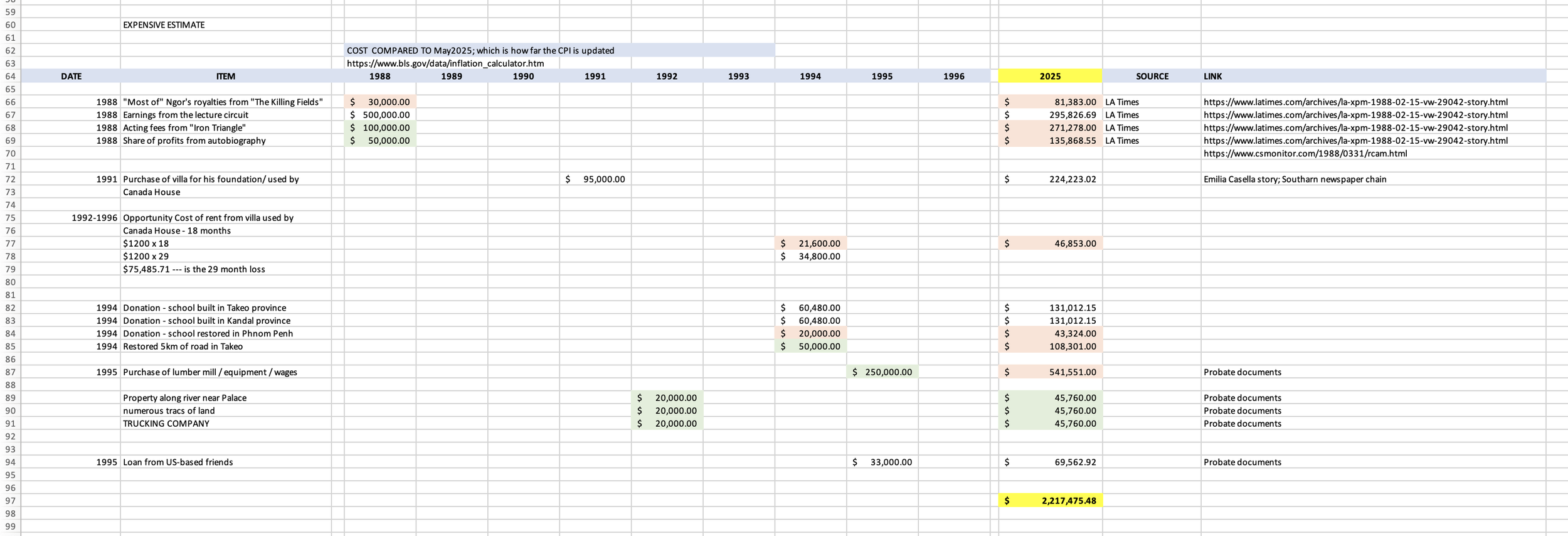
A snapshot of known exependitures.
Old friends - the transcript
In the first season of my podcast, I ended each episode with a request:
If you knew Haing Ngor personally and would like to contribute – even just an interesting anecdote - please get in touch. If you know any details about his murder you think are relevant, please get in touch.
Finally, someone did. And she was a goldmine.
My name is Patricia Nunan – and this is Who Killed Haing Ngor.
CC: He very ambitious. Especially he said to my father and my brother said, Look, my aim is my life. If I like somebody to address me as “doctor,” so I do absolutely anything to get the title “doctor” in front of my name.
This is CC. She’s asked me not to use her name; just her initials. She was born and raised in Cambodia’s capital, Phnom Penh. She was about 18 when the Khmer Rouge took over in 1975, and her life was upended.
A quick note: there are moments when some of my listeners might find CC’s accent a little bit tricky. But this is a very important g interview – it’s quite revealing about the last year of Ngor’s life. So I’m posting a transcript this on the “Who Killed Haing Ngor” webpage.
CC lives in Australia now. It was actually her daughter who first reached out - I’m going to call her Jane. “The Killing Fields” is such an important movie, that many Cambodians or people of Khmer heritage watch it every year, around January 7th. That’s the anniversary of when the Khmer Rouge were overthrown, in 1979.
After Jane’s rewatch, she came across my podcast. She emailed me about her “Uncle Haing,” whom she had met on a visit to Cambodia when she was about 12. We realized very quickly that her mom could be helpful to my investigation. CC’s friendship with Ngor goes back to adolescence.
In case you didn’t know? Jackfruit is a tropical fruit known for its rough exterior.
MPN: What were some nicknames you had?
CC: Well, just. I'm just being honest with you - because of his appearance, especially his facial appearance, because he have the residue mark of the pimples, and a very bad mark, yes. And we call him “jackfruit.”
MPN: Oh, no, that's so mean.
CC: It's so mean. And we call him that. We call him that? Yes, we call him. At first, he kind of growled at us. But he got used to it.
MPN: So what kind of guy was he?
CC: He’s a loudmouth, I must say. He liked to be heard.
Ngor dated CC’s older sister, toward the end of high school and into his medical school. Outside the US, med school often starts right after high school – during what Americans would call “undergrad.” CC’s sister eventually broke up with him. But Ngor remained close with the entire family.
Ngor was from Takeo province. In Phnom Penh, CC’s mother just about adopted him. That’s even after he started dating someone new. He used to get around town by motorbike. It was a white Vespa.
CC: He always respect[ed] my mother. Because when he was in medical school, he [was] always on his Vespa, come to my house, have lunch there, lie in the hammock under the tree there, study whatever he need to study. He eat, he drink and study there and go back to school at 2 o'clock in the afternoon. So the gap from 12 to 2, mostly he was there. We see him at least three times a week.
Then, in April 1975, the Khmer Rouge took over, and Cambodia turned itself inside out. CC was one of nine children in her nuclear family; part of a generation with more than a dozen cousins. She lost virtually everyone.
The Khmer Rouge were overthrown in 1979, and CC escaped to a refugee camp. She was now in her early 20’s. Her friends urged her to marry. They knew a guy, who seemed nice - and CC needed to team up with someone if she was going to survive. So she married him.
Fortunately, CC’s husband was a decent man. They were eventually resettled in Australia, and had three children. Years went by. One day, CC picked up a magazine, called “TV Week.”
CC: And I saw that when they making “The Killing Fields,” I saw his picture, maybe 1984, 85. And I saw. I said, “Oh.” I said to my husband, I said, “I know this man. That's Ngao Haing. I know him.” Whoever cast him, he cast the right person because that man is just everything - he can do anything.
You probably noticed – CC just pronounced Haing Ngor’s name correctly, the way Cambodians do – Ngao Haing. I’ve been using the Westernized version.
A few years later, a local charity held a screening of “The Killing Fields,” followed by a reception. Every Cambodian CC knew went to see it. Ngor was there.
CC: And when I went there, I saw him, and I walked to him. And when he saw me, he walked straight to me with his arms open - and he said, “Where's Mom?”
MPN: Oh, that's so lovely.
CC got up from our Zoom call and went to get some tissues.
CC: He said, Where's Mum? I said, Mum gone. And he got tears in his eyes and he hugged me.
[BREAK]
I wanted to share CC’s story with you for a couple of reasons. Being a movie star helped reunite Ngor with lost friends and family. And Ngor was capable of tremendous warmth. Others remember an angry, outspoken man.
CC knew them both. After all, they went so far back, she used to tease him about his acne.
In 1994, CC’s husband died. The following year, she and her children took his ashes home to Cambodia. CC’s daughter Jane was around 12, so for her and her siblings, Australian kids, it was something of a “roots” tour.
I want to emphasize the date. This trip happened in July 1995 – 7 months before Ngor was killed. During that visit, which lasted about two-three weeks, CC and her kids hung out with him nearly the entire time.
[BREAK]
MARION ROSENBERG: I remember him being very excited, very charming, always. He always used to say, no matter what time of day, what day it was, whatever it was, that his first words were always, “I'm so busy. I'm busy, busy.” “Busy, busy – that’s what he always used to say.
This is Marion Rosenberg. She’s another old friend of Ngor’s. She was his film and television agent in Los Angeles. She worked at the Lantz office, before opening up her own agency, the Marion Rosenberg Office. I interviewed her and her former assistant Greg Maher together over Zoom.
Marion ROSENBERG: : I received a phone call one morning from a very dear friend of mine, David Puttnam, who was the producer of “The Killing Fields.” He called me from London to say that the Academy Award nominations have just been announced. And much to everybody's delight and surprise, Haing Ngor had been nominated for a Best Supporting Actor award. Haing had no representation. He didn't have an agent. So I immediately told David Puttnam that I would be delighted to represent him, help him through the Academy Awards, and then see if he had the possibility of an acting career in front of him. And indeed, he did.
After "The Killing Fields," Ngor had several more roles. “Heaven and Earth,” by Oliver Stone; “My Life,” with Michael Keaton. There were television roles on “Miami Vice,” and “Highway to Heaven,” and too many other credits to name. Here’s Greg Maher.
MAHER: He sort of got typecast into playing like the Vietnamese general or the colonel, so, and so or - I don't think it really really bothered him so much. It's just, I think, there weren't like a lot of those kind of roles. So when they came up, he clearly, you know, wanted to work and he just sort of did them.
As clients go, Ngor was pretty low maintenance.
MAHER: He never played like the movie star. He was just, just Haing, you know, he wanted, he wanted to do more work, he wanted to make some more money and, you know, support the stuff that he was trying to do back home.
There’s one job Ngor did, for which he really didn’t mind being stereotyped. He played a Buddhist monk. You can find it on YouTube, if you search “IBM 1995 television commercial - monks.” Ngor is the second monk who appears.
MAHER: I remember him being a little bit unnerved by the fact that he had to shave his head. But my recollection is it was – it was quite a bit of money - and that, I think, assuaged his doubt about having to shave.
MPN: Yeah, I found that on YouTube, actually. I can send you the link. He's one of many Buddhist monks and it's IBM and they're communicating telepathically. It's a joke about how how smart IBM is.
Greg MAHER: That’s right. I remember now. That’s good.
MPN: Yeah, I was able to find that on YouTube.
Marion ROSENBERG: Yeah, he was very well paid for that. And if I can get to my files downstairs, I could actually tell you what it was paid for that.
MPN: I would love to know those numbers, actually, because we have to look into his debt issues.
Greg MAHER: I think I can remember it was a million bucks.
MPN: He made a million bucks from one commercial?
Marion ROSENBERG: No way.
Greg MAHER: Yes, I think so. I think so. Wait till you go find that slip.
Marion ROSENBERG: Are you telling me we made $100,000 out of that commercial?
Greg MAHER: I think we did.
MPN: Wow, that's a lot of money. I'd shave my head for a million dollars.
For the record, $1 million in 1995 is $2.1 million today.
Unfortunately, Rosenberg wasn’t able to locate Ngor’s booking slips. But they both remember he earned a significant sum – so I’m incorporating into my understanding of Ngor’s financial picture. Even if it were half that -- $500 thousand then, or a million dollars now - or a quarter million, even -- the monk commercial represented a windfall.
Of course, no one knew it at the time. But playing a Buddhist monk in an IBM commercial was Ngor’s last ever acting job.
[BREAK]
Back in Cambodia -- the first thing Jane remembered about meeting her Uncle Haing? He often wore a cap, because he was growing out a buzzcut, from when he played the monk. I asked CC about it.
MPN: So that. That monks commercial - did he tell you how much he made from that?
CC: No, did not. He just said look - or said, or “You will see me dressed as a monk. I do the IBM commercial. IBM computer commercial.” I said, “Okay.”
The larger question of Ngor’s finances are among the many details I’ve been sifting through from the last couple of years of his life. In Cambodia, he had a lot of irons in the fire.
To reiterate, here’s a quick list of some of Ngor’s projects and investments.
Ngor helped founded at least two small ngo’s: “Children of Angkor,” to support childhood education, and “Aid to Displaced Persons,” for refugees.
He built at least two schools and he restored a road in his home province, projects for which he teamed up with Cambodian Prime Minister Hun Sen. He restored at least one more school in the capital. He built a temple, and a small bridge. He bought properties, like an apartment – along the river He bought the villa that he intended use for the Haing Ngor Foundation. That’s the property that caused the feud with another humanitarian, that I went over my “Compassion Fad” episode.
He opened a small trucking company. He bought saw mill – so he could dive into Cambodia’s forestry sector. And according to CC, he also had a stake in two small hotels.
CC deliberately chose not to ask Ngor about his investments. She didn’t want to know any details. She knew he had business partners from Hong Kong, Malaysia and Singapore. She does not know any names.
One thing she knew for sure, though? Ngor was skating on thin ice.
CC: But I should say he was not a popular man back there.
MPN: He was not. Why?
CC : Wherever he goes, there always the gun under his seat.
MPN: I'm sorry, say again? He had a gun?
CC: Under his car seat.
MPN: He was afraid for his life?
CC: Yes.
MPN: This is in ‘95?
CC: He said sometime he afraid to pick up the phone because there's so many threat. I said, “Oh.” I said, “Look, it’s too much, [if you] can't stand [it,] get out of here. There's no reason to be here if you under threat all the time.”
CLIP: MPN. So who was threatening him?
CC: I don't know. But he said, because he said “I don't know how long I last here because there's so many threats against me.” I said, “Why you are here? If [there are] so many threats?” He said, “I don’t know. But I want to be here.”
CC’s point of view is significant, because as a Cambodian, she was sensitive to the cultural dynamics at play. It was why I was so keen to talk to her after Jane reached out.
Even thought she was trying not to, she actually knew some details about Ngor’s businesses and social circles. Like the lumber mill Ngor bought. He took CC and the kids out to the site, because it was along a river, so the kids could swim.
CC: No, there's not much there. There's a little thing. There's a bench there. There's a few logs there and everything. But it's not ready to operate. MPN: But were there machines there for working on the timber?
CC: Scarcely. I think one or two. One or two. That's why I said he never got [it] off the ground.
And that’s all she knew. But we’re coming back to the lumber mill soon.
[BREAK]
I want to take a break from my interview with CC to bring back Dorothy Chow. We met her in my second episode, the “Khmer Rouge Misdirect.” That’s when I debunked the conspiracy theory that the Khmer Rouge killed Haing Ngor.
Chow’s parents escaped the Khmer Rouge, and later resettled in northern California, where she was born. Her podcast, “Death in Cambodia - Life in America,” is about her father’s experience surviving the Khmer Rouge, and starting over again, in the States.
Chow has spearheaded support groups for people like her – the adult children of refugees. The goal is to help people understand their parents’ PTSD - to stem the tide of intergenerational trauma.
Chow’s too young to remember the murder of Haing Ngor. But her father remembered it well.
CHOW: Whatever the news outlets said, and whatever stories are being we're being told, he believed that it was somebody within the Cambodian community. There's this narrative within the Cambodian community that like, “We don't support each other, and we're always dragging each other down.” If you're familiar with the concept of crabs in a bucket, where if one crab tries to get up, the other crabs are going to try to keep him down, and everybody stays down. It's unfortunate, and it's something that the second generation is trying to change. But he very much believed that it was somebody within the Cambodian community who could not stand to watch one of their fellow Cambodians be so successful.
[BREAK]
Back in Cambodia – it’s July 1995 – seven months before Ngor’s murder. He kept a gun under the seat of his car. He was getting so many death threats, he hated answering the phone.
One thing the Innocence Center and I already knew was that Ngor was running with a very tough crowd.
Ngor’s brother is Chan Sarun. I’ve mentioned him before – he was the Director of Forestry – an extremely powerful post in a very dangerous economic sector.
Ngor had done development projects with Prime Minister Hun Sen.
Here’s something I didn’t know. Ngor’s had a mentor named Chea Sim. He was the president of the Cambodian People’s Party, the CPP, making him a top aide to Hun Sen.
Chea Sim had an adult daughter, who was single. And she had a big fat crush – on Ngor. It’s something CC teased him about.
CC: Everyone knew that one of Chea Sim’s daughter loves him, wants to be with him. And I teased him and said, “Hey, why not?” And he just growled at me and said, “Look, I'm not that stupid.”
“I’m not that stupid.” That’s stands out to me. Ngor had an opportunity to marry into the Cambodian elite. But to him, that would be dumb.
Ngor was a bundle of contradictions. That’s one thing this investigation is making clear.
His warmth alternated with abrasiveness. He lost his wife – and the love of his life - to the Khmer Rouge; a loss so painful he never got past it. Later, he didn’t have a problem with sleeping around.
Still – he had a strong moral code. He never evicted the orphanage squatting on his property, even though he had the law and powerful players on his side. That’s from the “Compassion Fad” episode.
Given the chance, some might leap at a marriage of convenience, to ascend to Cambodia’s most elite circles. Ngor seems to have known how toxic and dangerous that would be. To me, that’s important.
He didn’t pursue it. Instead, he put up with receiving a steady-stream of death threats on his phone.
[BREAK]
As Ngor’s friend Roger Warner, and now CC have both shared, Ngor could be an arrogant jerk – especially to Cambodians.
On trips to the provinces, where Ngor had projects, CC said ordinary Cambodians loved him, because “The Killing Fields” told their story so magnificently well. To them, he was a hero.
In addition to that “crabs in a bucket” dynamic, there was another issue at play. Cambodia had just opened up after decades of bloodshed and isolation. Tension often arose between Cambodians who came home after the peace deal was signed, and those who had stayed behind through the bitter years of civil war. This is not just about Ngor. This was widespread.
Roland Eng is a former Ambassador at Large for the Royal Government of Cambodia.
ROLAND ENG: And they introduce themselves like, you know, “I'm American-Cambodian.” So this is the mindset. You have to shift the mindset. Psychologically it’s very, very important. And it is understanding that those people who were not able to leave the country during the war have suffered during the whole period of instability in Cambodia. Yeah, they have resentment there. You left the country, You're a traitor. You're having a good life when we're suffering. This is a normal process. I mean, this is life. It's happening all around the country, all over the country.
When the Khmer Rouge were ousted – it was by Vietnam. They invaded in 1979 and occupied Cambodia for a decade.
In fact, it was communist Vietnam that installed the government run by Prime Minister Hun Sen, Chea Sim and to a lesser extent, Ngor’s brother, Chan Sarun. These are big names in the Cambodian People’s Party – the CPP, which came to power after the Khmer Rouge.
These are the people Ngor associated with. And that makes perfect makes sense: Ngor came home and reconnected with his brother.
Now - the Khmer Rouge were obviously extremists. But for Chan Sarun and others in the CPP, there was a lingering belief that communism could be done right. Or at least, what was evolving into Vietnamese-style socialism.
Here’s what blows my mind: Ngor used to actually start conversations in which he openly dissed communism and praised capitalism, according to CC.
That made a lot of people angry, including his brother.
Here, CC’s doing an impression of Ngor.
CC: “I'm an American, I become American now.” And they’re just freshly out of the communis[m]. “I don't like communists, blah, blah, blah.” That's a blasé attitude. I said, you can't go there and broadcast that: “I'm from the capitalism.” I said to him, “You can’t be that blasé.”
MPN: So would you call that arrogance?
CC: Oh, too much - highly arrogant. Highly arrogant. Because he believed, deep down in his head, “I got American passport, I'm safe. That’s my protection.” I said, “No, it's not. It's not.”
Around this time, Ngor fell out with his brother, Chan Sarun.
CC: .They had a big fight. The one that you know, broadcast capitalism and the one broadcast the other thing. So they’re just pole[s] apart.
Chea Sim died in 2015. Prime Minister Hun Sen stepped aside in 2023, in favor of his son, Hun Manet, who is now prime minster. Hun Sen is now president of the Cambodian senate. Chan Sarun is retired but remains a prominent figure. Again, I promise – we’re coming back to them.
[BREAK]
So after all this, who does CC think killed Haing Ngor? Of course, she doesn’t know.
CC: He just traumatized by so many things. I think he got involved in so many things that out of his control. Because he think that his name is so big. He just spread himself so thin. That's how I see it. He believed that, “I'm the big guy now. I'm famous. The only Cambodian that got an Oscar.” That’s in his system. Big head - become very big head.
MPN: Because I'll tell you the one thing people ask me all the time is, if he died because of business issues in Cambodia, why wouldn't people kill him in Cambodia? Like - why was it in America?
CLIP: CC: It's too obvious. It’s too obvious. They can turn it into [a] political [issue]- and it can turn into something else. With ordinary people's sentiment toward him - that's why they don't want to do that. That's my opinion. I think that - all the people think that he's a hero. Over in the United States, it’s less likely to turn political.
Ngor’s enemies had to kill him in Los Angeles, because the popular uproar over the murder of this hero would requie action from the highest levels of government. In Cambodia, the killers would have to be caught. That’s CC’s take.
[BREAK].
CC’s daughter Jane told me how she still remembers coming home from school one day to find her mother crying. She had heard the news that Ngor was dead. He was killed February 25, 1996 – again, seven months after CC took her family to Cambodia.
In the chaos and confusion surrounding his death, CC managed to connect with a girlfriend of Ngor’s in Phnom Penh. CC had not met her on her trip the previous July. But she was trying to get a sense of what happened, and someone gave her this woman’s phone number.
This girlfriend served as Ngor’s administrative assistant. And she wanted to marry him.
CC: She said to me that, “I really want to have a child with him, but him - because he's a doctor, he knows the way not to have a child with me.” That what she said to me. And “I really want to marry him, but he's just, you know, kind of slippery. He doesn't want that to happen.”
She even - what she told me: she borrowed money to prop up his business. That what she told me. I said, I asked her, I said, “If you don't mind, can you tell me how much?” She said, his debt about … under US$50,000 back then. I said, “Oh, that's a lot of money.” And she said, “I don't know, how can I find the money to repay that? Because every money that he borrowed [was] under my name.”
MPN: He borrowed money under her name. And then when he died, she was left with debt?
CC: That's right. That's what she told me.
Fifty thousand dollars in 1995 is over $105 thousand dollars today.
I know the woman CC’s talking about. She disappeared and was at one point presumed dead by Ngor’s family –they tried to find her when they were sorting out probate.
But this woman managed to leave Cambodia, and she lives in the United States. In the nearly 30 years since Ngor’s death, I was the first to let CC know.
CC: Oh, that's good. I'm so glad. I'm so pleased to know that. Because she, she did everything for him and she was hoping she can go to live in the United States. If she could go, good on her. Good on her.
I’ve reached to this woman, to ask if she’d participate in this podcast, but I have never gotten a response. Frank, from the Innocence Center, tracked her down early in their investigation. They chatted for a few minutes. But when the subject turned to Ngor, suddenly - she didn’t speak English.
[BREAK]
For the record, neither Marion Rosenberg and Greg Maher bought the police narrative that Ngor was killed in a botched robbery. It just seemed too convenient. I’ll come back to them in future episodes.
Now - let’s think back to the monks commercial, that Ngor did for IBM. It may have earned him as much as $1 million -- or $900 thousand, after his agents took their 10 percent. Even without an exact figure, both Rosenberg and Maher remember, it was a windfall.
This means in July 1995, when Ngor was still growing out his shaven head from the monks commercial, he was cash-rich. He had liquidity. That’s in stark contrast to 1994, in the midst of the orphanage dispute. That’s when he told journalist Emilia Casella he simply didn’t have the money to rent another space.
Then within seven months of his windfall, he was borrowing money in his girlfriend’s name. What on earth happened there?
In my next episode, we’ll dive into Ngor’s investment in the forestry sector – a decision a lot of people link to his death.
My name is Patricia Nunan, and this is Who Killed Haing Ngor?
If you’d like to reach out, I’m at whokilledhaingngor@gmail.com. If you knew Haing Ngor, please get in touch. I’m also on Telegram, as mpnunan
If you’d like to support the investigation, there’s a donation button on my webpage, at whokilledhaingngor dot-com. Also – I’m putting a transcript to this episode there, on the webpage.
Thank you for your support. And thank you for listening!
[ENDS]
Written by Jon Swain
Jon Swain generously sent copies of some of his clippings from 1975, from The Sunday Times.

The Sunday Times, March 2, 1975
by Jon Swain


The Sunday Times, April 13, 1975
by Jon Swain
Diary of a Doomed City. A 5 page spread published in The Sunday Times on May 11, 1975
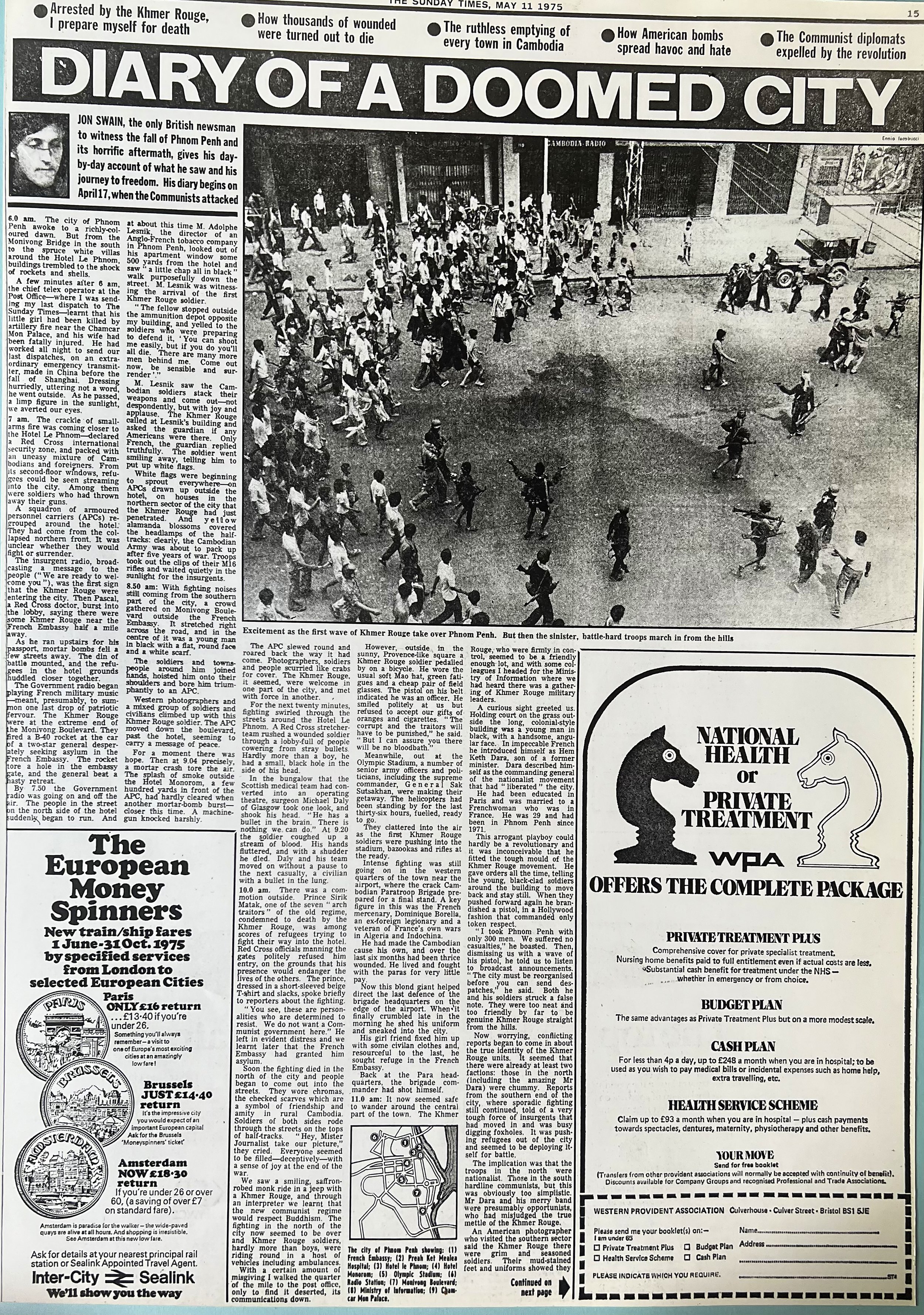

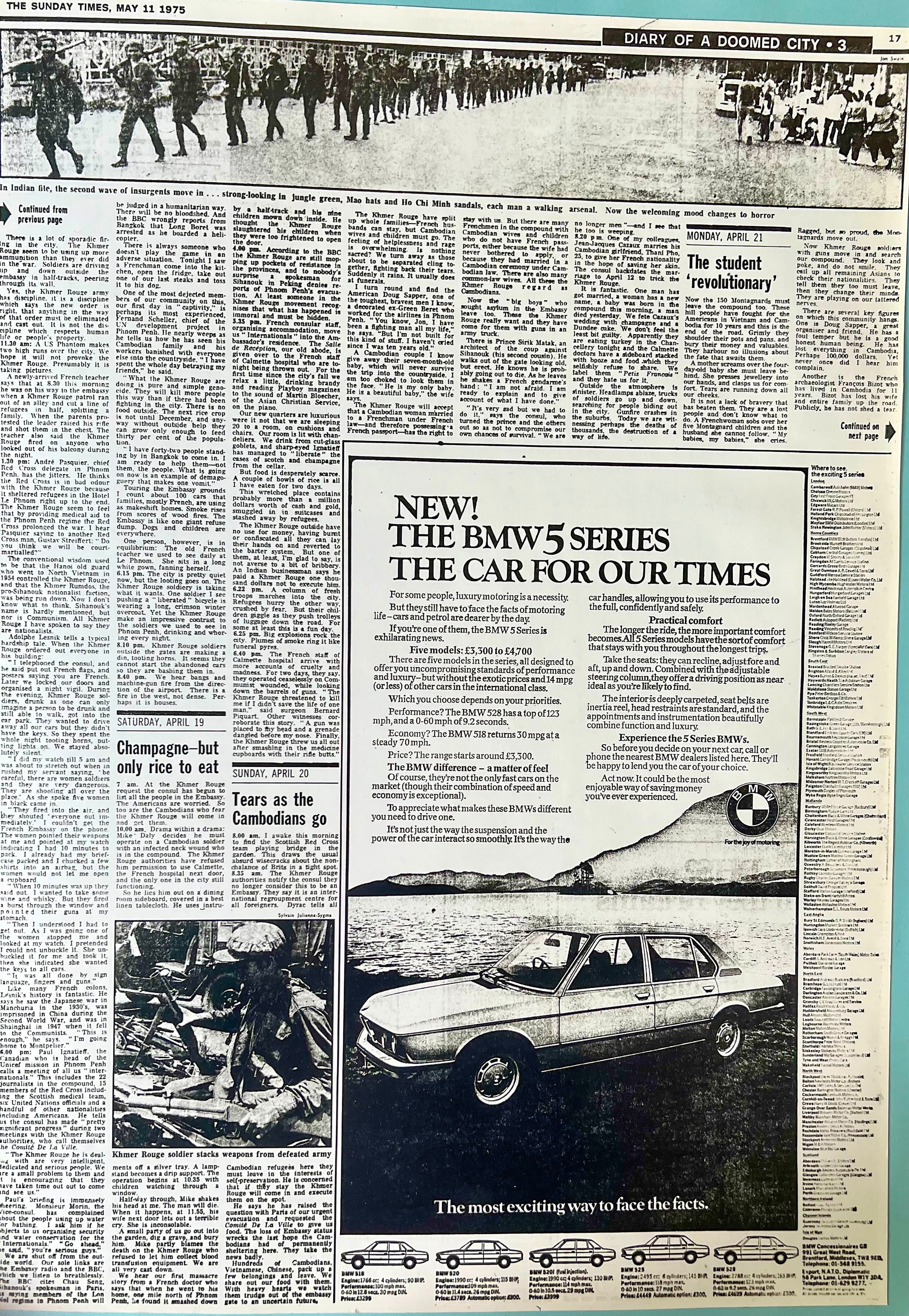

Why Duch’s Quote Makes No Sense
-
The Khmer Rouge seize control of Phnom Penh.
-
The Khmer Rouge are overthrown by the Vietnamese military. Pol Pot and his top aides flee to Cambodia’s “Wild West” border with Thailand. Cvil war erupts.
-
“The Killing Fields,” a Roland Joffe film starring Haing Ngor as “The New York Times” reporter Dith Pran is released.
-
Haing Ngor wins the Oscar for Best Supporting Actor for his role as Dith Pran.
-
The Berlin Wall falls. The East-West stalemate that saw Cambodia used as a proxy-war for the big powers has crumbled. The international community turns its attention toward “fixing” long-neglected Cambodia.
-
Cambodia’s four warring factions - including the Khmer Rouge - sign the Paris Peace Accords, ushering a massive United Nations peacekeeping mission into Cambodia.
-
The Khmer Rouge pull out of the peace deal. This will eventually be seen as a gross strategic miscalculation on their part.
-
The UN-supervised elections are hailed as a massive success.
Cambodia begins to form its new government. The only hitch? Incumbent Prime Minister Hun Sen refuses to step down. The UN cobbles together a compromise: election winner, Prince Norodom Ranariddh is the First Prime Minister; Hun Sen is the Second Prime Minister.
-
United Nations peacekeepers withdraw from Cambodia, once again heralding their $2 billion mission a success.
-
Haing Ngor is murdered in Los Angeles in what authorities call a robbery gone wrong.
-
Second PM Hun Sen overthrows Prince Ranariddh in a coup-d’état.
Hun Sen overturned the results of the Cambodia’s first ever democratic election - and its a $2 billion price tag.
With compassion fatigue setting in, the UN, ASEAN, EU and the rest of the international community go through the motions of objecting. But ultimately - they collectively shrug.
-
Approximate date of when Nic Dunlop finds Comrade Duch in Samlaut, Cambodia on the first of three reporting trips to the area.
-
Kaing Guek Euv, also known as “Duch”, testifies before Cambodia’s Khmer Rouge tribunal that Pol Pot ordered the murder of Haing Ngor.

The Mysterious Ruom Ritt
Photo by MPN
Back in the ‘90’s in Phnom Penh, I used to earn extra money by translating Palace statements and other documents from French to English. Frequently, I was translating the words of Cambodia’s King Sihanouk.
King Sihanouk had one of those extraordinary - and tragic - 20th century lives, that can never possibly be replicated.
Chosen as a child by French colonial leaders to be a figurehead, his life is inextricably woven into Cambodia’s independence, the “Sideshow” period that saw Cambodia as collateral damage to the Vietnam War, the Khmer Rouge revolution, the years of civil war; and the UNTAC and Hun Sen eras. This is the best obituary of King Sihanouk, by my friend Kevin Barrington.
Translating all those Palace statements made me feel like I got to know King Sihanouk (who, by the way, abdicated the crown at one point and was for years “Prince” Sihanouk, til he later regained the crown, which he later abdicated again. A 20th century one-off.)
In the ‘90’s, the so-called figurehead king, who famously - and only purportedly - “reigned by did not rule,” genuinely was relevant to Cambodian politics. His opinion mattered — just not as much as he wanted it to.
Sihanouk was steadily being outmaneuvered by Prime Minister Hun Sen. The PM still had to kow-tow to the king to an extent - but Hun Sen knew he was winning the match.
So Sihanouik’s writing had a slight air of desperation: I’m the King, take me seriously. At the same time, his fatigue was evident. Reading between the lines, it was clear to me that this man, then in his 70’s, wanted to retire.
This brings us to Ruom Ritt.
Playing heed to this notion that the King was meant to be above politics, King Sihanouk invented a correspondence between himself and a childhood friend, Ruom Ritt, an ex-patriate Cambodian living in in the south of France.
Ruom Ritt would politely inquire about political goings-on in Cambodia, what the king thought of them, and what role the king thought the Palace should play.
It was bizarre to me even then. Summaries of these conversations between the King and Ruom Ritt were written in long-hand, in French, and faxed to news outlets, as part of the “BMD,” or le Bulletin Mensuel de Documentation (the Monthly Documentation Bulletin.)
It was plainly obvious that Ruom Ritt was King Sihanouk, and the “correspondence” was another ploy to make the King feel relevant to the political scene. This went on from the 1990’s until at least the early aughts.
Not surprisingly, in a lot of this “correspondence,” King Sihanouk took jabs at Hun Sen.
Eventually, Hun Sen got angry at Ruom Ritt. In 2003, he suggested that the King share his friend’s address.
King Sihanouk shot back, No – because he wouldn’t want his friend Ruom Ritt to be murdered like Haing Ngor.